Source: High school physics (Chinese)
Problem
In the circuit of Fig. 13.47, four nodes are arranged as a rectangle: $A$ (top-left), $C$ (top-right), $B$ (bottom-left), $D$ (bottom-right). The resistor $R_1$ is on the left side between $A$ and $B$; $R_2$ is on the top between $A$ and $C$; $R_3$ is the diagonal between $B$ and $C$; $R_4$ is on the bottom between $B$ and $D$. A switch $S$ is on the right side between $C$ and $D$. All four resistors are equal: $R_1 = R_2 = R_3 = R_4 = R$.
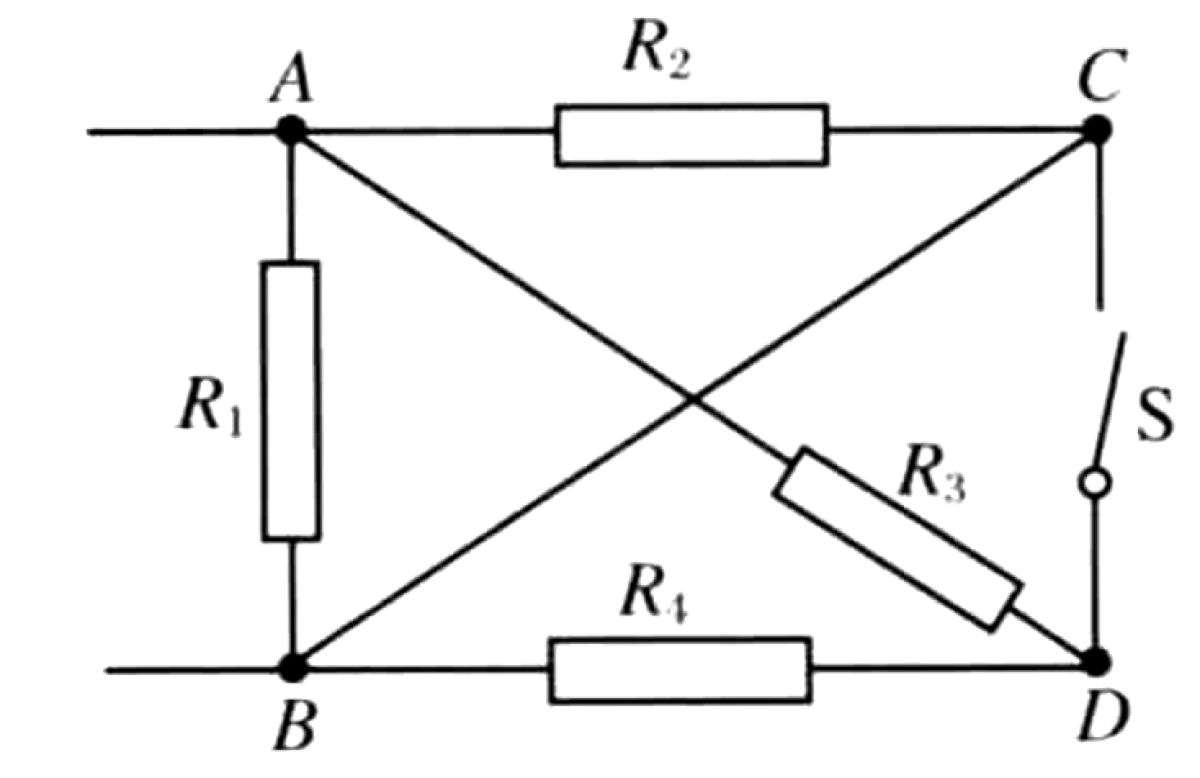
Switch $S$ open. With $S$ open, node $D$ is connected to the rest of the circuit only through $R_4$, so no current flows through $R_4$ and $D$ is effectively isolated. The remaining paths from $A$ to $B$ are:
- Direct: $R_1 = R$
- Via $C$: $R_2 + R_3 = 2R$
In parallel:
$$R_{AB}^{\text{open}} = \frac{R \cdot 2R}{R + 2R} = \frac{2R}{3}$$Switch $S$ closed. Closing $S$ merges nodes $C$ and $D$. From the merged node $C\!=\!D$ to $B$ there are two parallel resistors $R_3$ and $R_4$:
$$R_{3} \parallel R_{4} = \frac{R}{2}$$The path $A \to C(\!=\!D) \to B$ has resistance $R_2 + R/2 = 3R/2$. This is in parallel with $R_1$:
$$R_{AB}^{\text{closed}} = \frac{R \cdot 3R/2}{R + 3R/2} = \frac{3R^2/2}{5R/2} = \frac{3R}{5}$$Ratio.
$$\frac{R_{AB}^{\text{closed}}}{R_{AB}^{\text{open}}} = \frac{3R/5}{2R/3} = \frac{9}{10}$$