Source: High school physics (Chinese)
Problem
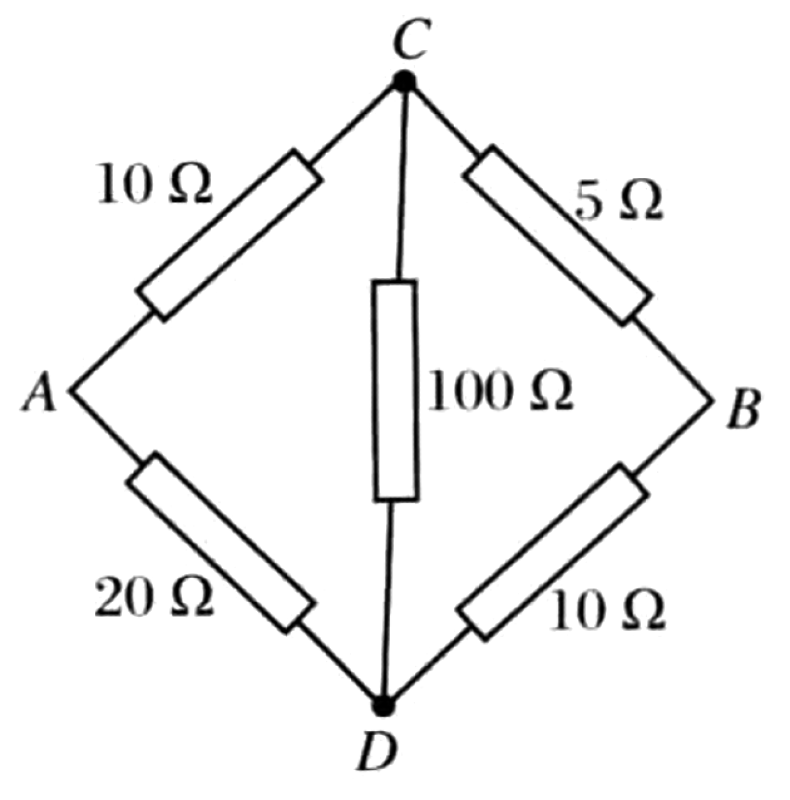
In the bridge network of Figure, four nodes $A$, $B$, $C$, $D$ are arranged as the vertices of a diamond. The outer resistors are $R_{AC} = 10$ $\Omega$ (between $A$ and $C$), $R_{CB} = 5$ $\Omega$ (between $C$ and $B$), $R_{AD} = 20$ $\Omega$ (between $A$ and $D$), $R_{DB} = 10$ $\Omega$ (between $D$ and $B$), and a bridge resistor $R_{CD} = 100$ $\Omega$ across the diagonal between $C$ and $D$. Find the equivalent resistance when the following pairs of terminals are connected to a circuit:
- $R_{CD}$ (terminals at $C$ and $D$).
- $R_{BC}$ (terminals at $B$ and $C$).
- $R_{AB}$ (terminals at $A$ and $B$).
(1) $R_{CD} = 100/11 \approx 9.09$ $\Omega$; \quad (2) $R_{BC} = 430/99 \approx 4.34$ $\Omega$; \quad (3) $R_{AB} = 10$ $\Omega$.
(1) $R_{CD}$. Inject current at $C$, draw it out at $D$. Setting $V_C = V$ and $V_D = 0$ and using Kirchhoff at $A$ and $B$:
$$\frac{V-V_A}{10}=\frac{V_A}{20} \Rightarrow V_A = \tfrac{2}{3}V, \qquad \frac{V-V_B}{5}=\frac{V_B}{10} \Rightarrow V_B = \tfrac{2}{3}V$$Since $V_A = V_B$, the two side branches behave as parallel combinations from each terminal. From $C$ to the common potential: $10 \| 5 = 10/3$ $\Omega$. From $D$ to it: $20 \| 10 = 20/3$ $\Omega$. In series: $30/3 = 10$ $\Omega$. This series path is in parallel with the bridge $100$ $\Omega$:
$$R_{CD} = \frac{10 \times 100}{10 + 100} = \frac{100}{11} \approx 9.09 \text{ }\Omega$$(2) $R_{BC}$. Apply a $Y$-$\Delta$ transformation to the triangle $C$-$B$-$D$ (resistors $5$, $10$, $100$, sum $115$). The star resistors at common node $O$ are:
$$r_C = \frac{5 \times 100}{115} = \frac{100}{23},\ r_B = \frac{5 \times 10}{115} = \frac{10}{23},\ r_D = \frac{10 \times 100}{115} = \frac{200}{23}$$After the transformation, $B$ connects only through $r_B$ to $O$. From $O$ to $C$ there are two parallel paths: directly through $r_C = 100/23$, or via $O$-$D$-$A$-$C$ with resistance $200/23 + 20 + 10 = 890/23$. Their parallel combination is $\frac{(100/23)(890/23)}{(100/23)+(890/23)} = \frac{8900}{2277}$ $\Omega$. Adding $r_B$:
$$R_{BC} = \frac{10}{23} + \frac{8900}{2277} = \frac{990 + 8900}{2277} = \frac{9890}{2277} = \frac{430}{99} \approx 4.34 \text{ }\Omega$$(3) $R_{AB}$. Check the Wheatstone balance condition: $R_{AC}/R_{AD} = 10/20 = 1/2$ and $R_{CB}/R_{DB} = 5/10 = 1/2$. They match, so the bridge is balanced and no current flows through the $100$ $\Omega$ bridge resistor. The two side branches act independently:
$$R_{ACB} = 10 + 5 = 15 \text{ }\Omega, \qquad R_{ADB} = 20 + 10 = 30 \text{ }\Omega$$ $$R_{AB} = \frac{15 \times 30}{15 + 30} = 10 \text{ }\Omega$$