Source: High school physics (Chinese)
Problem
A battery with EMF $\varepsilon$ and internal resistance $r$ drives two parallel branches:
Branch 1: resistor $R_1$ in series with an ammeter (treated as ideal, with negligible resistance).
Branch 2: resistor $R_2$ in series with switch $S$.
Initially, switch $S$ is closed.
When switch $S$ is opened, how does the ammeter reading change?
A. If $r = 0$, the reading increases; if $r e 0$, the reading decreases.
B. If $r = 0$, the reading decreases; if $r e 0$, the reading increases.
C. The reading increases in both cases.
D. If $r = 0$, the reading is unchanged; if $r e 0$, the reading increases.
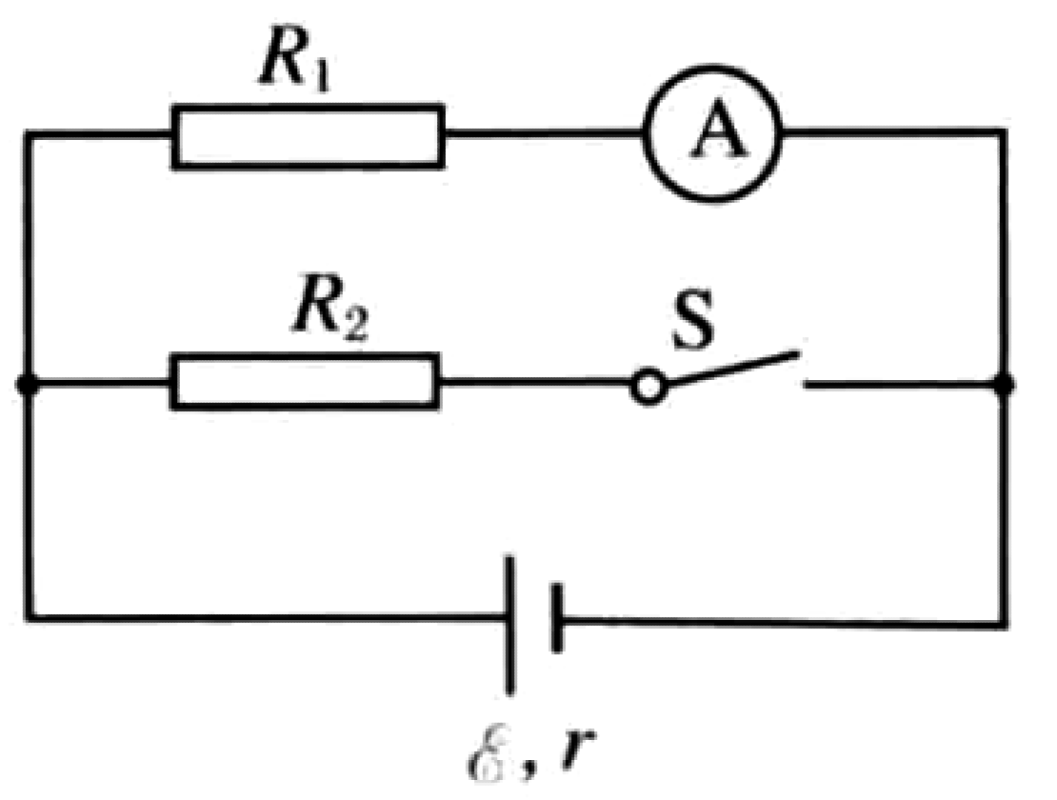
If $r = 0$, ammeter reading unchanged; if $r e 0$, reading increases (Choice D)
Let $I_A$ denote the ammeter reading.
S closed: The terminal voltage of the battery is $U_{\text{term}} = \varepsilon - I r$, where $I$ is the total current. The voltage across branch 1 equals $U_{\text{term}}$, so:
$$I_A^{\text{closed}} = \frac{\varepsilon - I r}{R_1}$$Equivalently, since both branches have voltage $U_{\text{term}}$:
$$I_A^{\text{closed}} = \frac{\varepsilon \, R_2}{r(R_1 + R_2) + R_1 R_2}$$S open: Branch 2 is disconnected, so only $R_1$ and the ammeter form the circuit:
$$I_A^{\text{open}} = \frac{\varepsilon}{R_1 + r}$$Case $r = 0$: $I_A^{\text{closed}} = \dfrac{\varepsilon}{R_1}$ and $I_A^{\text{open}} = \dfrac{\varepsilon}{R_1}$. The reading does \emph{not} change. (Without internal resistance, the parallel branch does not affect the voltage across branch 1.)
**Case $r e 0$:** When $S$ opens, the total circuit resistance increases from $r + (R_1 \parallel R_2)$ to $r + R_1$, so the total current $I$ decreases and the $I r$ drop across the internal resistance decreases. Hence the terminal voltage $U_{\text{term}} = \varepsilon - I r$ \emph{increases}, increasing the voltage across $R_1$ and the current through it. The ammeter reading increases.
Answer: D.