Source: High school physics (Chinese)
Problem
In the circuit, every resistor has the same resistance $r$ and the same rated power. Two parallel branches are connected across the source voltage $U$:
Branch 1: $R_1$ in parallel with $R_2$ (between the left terminal and node $M$), then $R_5$ from $M$ to the right terminal.
Branch 2: $R_3$ in series with $R_4$, between the left and right terminals.
When the source voltage $U$ is gradually increased, which resistor will burn out first?
A. $R_1$ and $R_2$
B. $R_3$
C. $R_4$
D. $R_5$
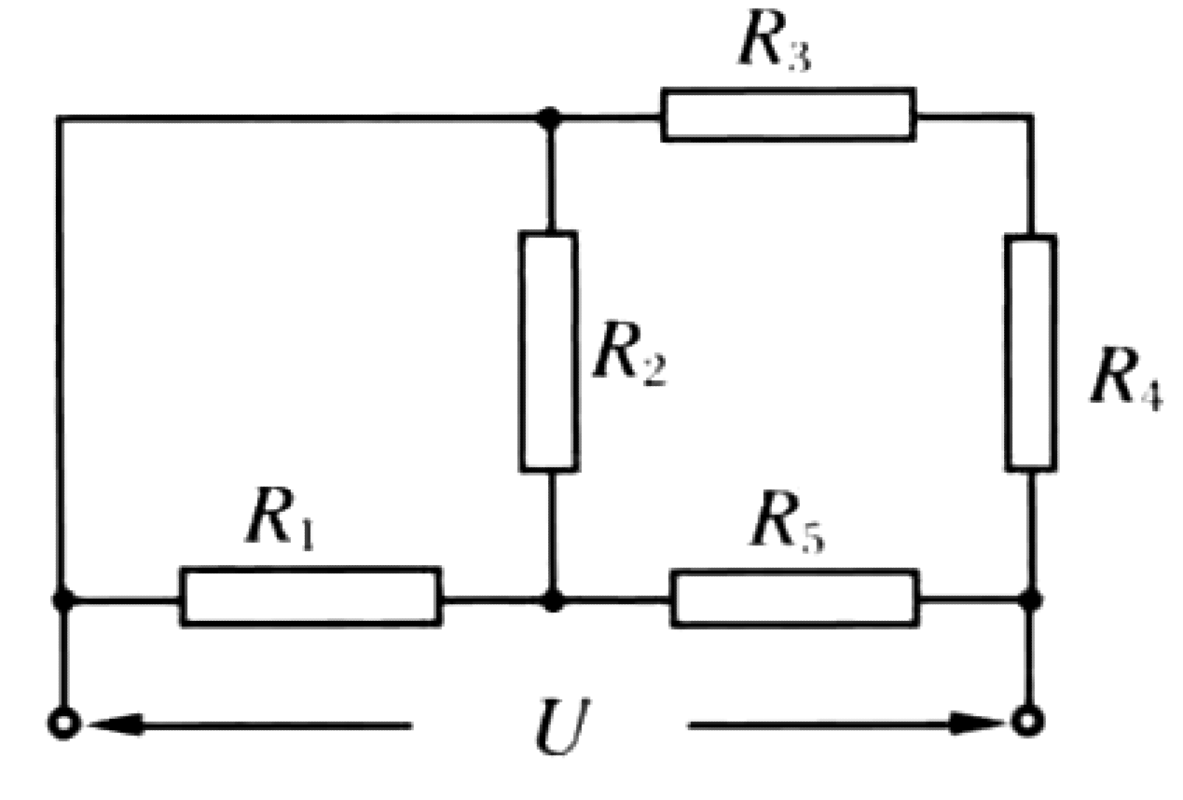
With every resistance equal to $r$, the resistor with the largest current dissipates the most power ($P = I^2 r$) and will burn out first.
Branch 1 resistance: $R_1 \parallel R_2 + R_5 = \dfrac{r}{2} + r = \dfrac{3r}{2}$.
Branch 2 resistance: $R_3 + R_4 = 2r$.
Branch currents (each branch sees voltage $U$):
$$I_1 = \frac{U}{3r/2} = \frac{2U}{3r}, \qquad I_2 = \frac{U}{2r}$$Currents through individual resistors:
- $R_5$ carries the full branch-1 current: $I_{R_5} = \dfrac{2U}{3r}$
- $R_1$ and $R_2$ split $I_1$ equally: $I_{R_1} = I_{R_2} = \dfrac{U}{3r}$
- $R_3$ and $R_4$ each carry $I_2 = \dfrac{U}{2r}$
Comparing: $\dfrac{2U}{3r} > \dfrac{U}{2r} > \dfrac{U}{3r}$, so $R_5$ has the largest current and hence the largest power. It burns out first.
Answer: D.