Source: High school physics (Chinese)
Problem
Two bulbs $A$ and $B$ are both rated at $110 \text{ V}$, with rated powers $P_A = 100 \text{ W}$ and $P_B = 40 \text{ W}$. They are to be connected to a $220 \text{ V}$ supply using a variable resistor (rheostat), so that both bulbs operate at their rated values. Four possible connection schemes are shown:
Scheme A: Rheostat in parallel with the series combination ($A$ in series with $B$).
Scheme B: Bulb $B$ in series with the parallel combination (rheostat in parallel with bulb $A$).
Scheme C: Bulb $A$ in series with the parallel combination (rheostat in parallel with bulb $B$).
Scheme D: Rheostat in series with the parallel combination (bulb $A$ in parallel with bulb $B$).
Which scheme makes both bulbs operate normally while minimizing the total power consumed by the circuit?
A. Scheme A
B. Scheme B
C. Scheme C
D. Scheme D
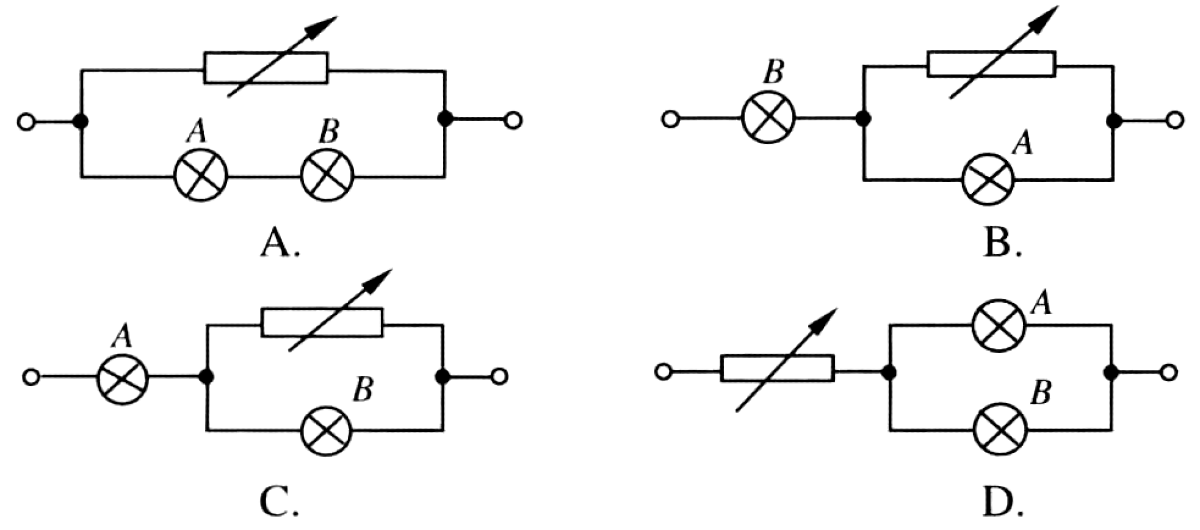
Scheme C (total power $= 200 \text{ W}$, with $60 \text{ W}$ in rheostat)
Rated currents:
$$I_A = \frac{P_A}{U} = \frac{100}{110} = \frac{10}{11} \text{ A}, \qquad I_B = \frac{P_B}{U} = \frac{40}{110} = \frac{4}{11} \text{ A}$$Since $I_A e I_B$, the bulbs cannot share the same current. Therefore Schemes A (bulbs in series) and B (where main-line current through $B$ would need to be $I_B < I_A$ but must also supply $A$) are impossible.
Scheme C: Bulb $A$ carries the main current $I_A = 10/11 \text{ A}$. After $A$, the parallel section ($R \parallel B$) sees $220 - 110 = 110 \text{ V}$. Bulb $B$ takes $I_B = 4/11 \text{ A}$, so the rheostat carries $I_R = I_A - I_B = 6/11 \text{ A}$. Power dissipated in $R$:
$$P_R^{(C)} = 110 \times \tfrac{6}{11} = 60 \text{ W}$$Total power: $P_A + P_B + P_R = 100 + 40 + 60 = 200 \text{ W}$.
Scheme D: Bulbs in parallel both get $110 \text{ V}$ ✓. Main current $I = I_A + I_B = 14/11 \text{ A}$. The rheostat (in series) drops $220 - 110 = 110 \text{ V}$. Power dissipated in $R$:
$$P_R^{(D)} = 110 \times \tfrac{14}{11} = 140 \text{ W}$$Total power: $100 + 40 + 140 = 280 \text{ W}$.
Scheme C wastes only $60 \text{ W}$ in the rheostat, less than Scheme D's $140 \text{ W}$. Answer: C.