Source: High school physics (Chinese)
Problem
Three bulbs $A$, $B$, $C$ are all lit in a circuit. Bulb $A$ is in series with the battery and the rest of the circuit. After $A$, the circuit splits into two parallel branches: one branch contains bulb $B$ in series with the active portion of a sliding rheostat (the portion of the rheostat between the slider $P$ and its lower terminal is used), and the other branch contains bulb $C$ alone.
When the slider $P$ of the rheostat is moved downward, how do the brightnesses of the three bulbs change?
A. $A$, $B$, $C$ all get brighter
B. $A$, $B$ get brighter; $C$ gets dimmer
C. $A$, $C$ get brighter; $B$ gets dimmer
D. $A$ gets brighter; $B$, $C$ get dimmer
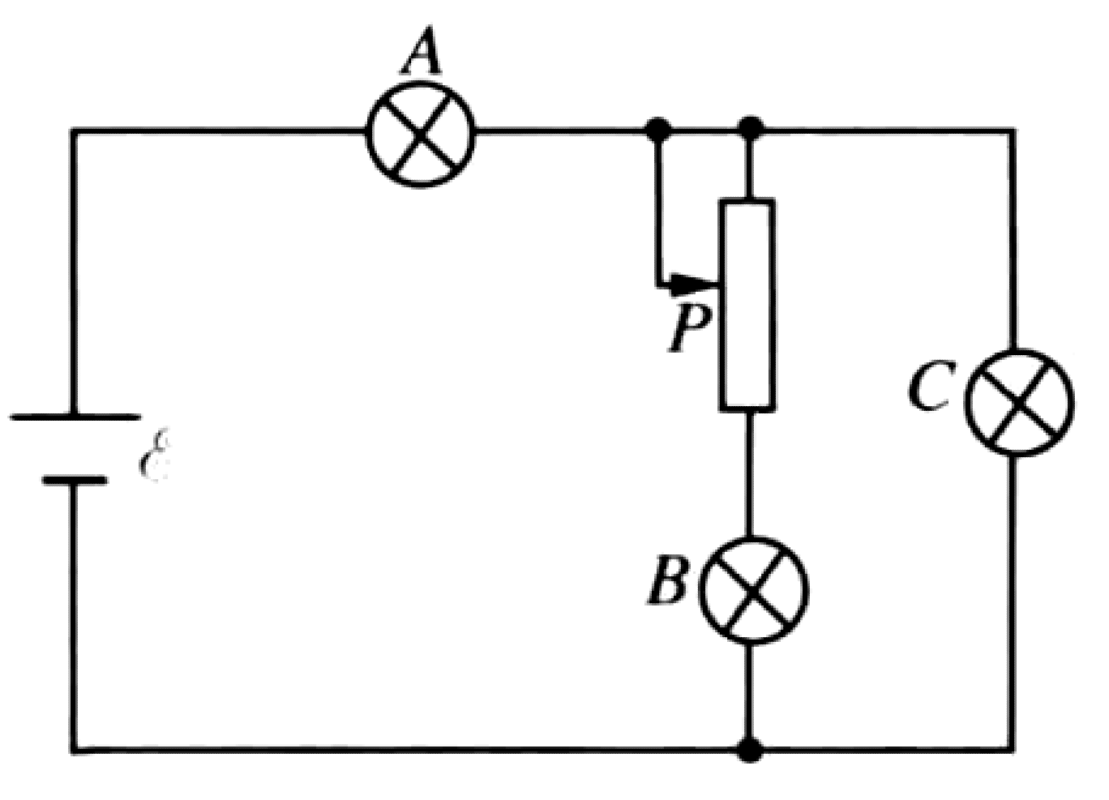
Let $R_x$ be the active rheostat resistance (between slider $P$ and the lower terminal). As $P$ moves down, $R_x$ decreases.
Branch 1 ($B$ in series with rheostat): resistance $R_B + R_x$ decreases.
Branch 2 ($C$ alone): resistance $R_C$ is unchanged.
Parallel combination: $R_{\parallel} = \dfrac{(R_B + R_x)\, R_C}{(R_B + R_x) + R_C}$ decreases.
Total circuit resistance $R_{\text{tot}} = R_A + R_{\parallel}$ decreases, so the total (main) current $I = \dfrac{\varepsilon}{R_{\text{tot}}}$ increases. Hence $A$ becomes brighter.
Voltage across the parallel section: $U_{\parallel} = \varepsilon - I R_A$ decreases (since $I$ increases).
Current through $C$: $I_C = \dfrac{U_{\parallel}}{R_C}$ decreases, so $C$ becomes dimmer.
Current through $B$: $I_B = I - I_C$ increases (since $I$ increases and $I_C$ decreases), so $B$ becomes brighter.
Answer: B.