Source: High school physics (Chinese)
Problem Sets:
Problem
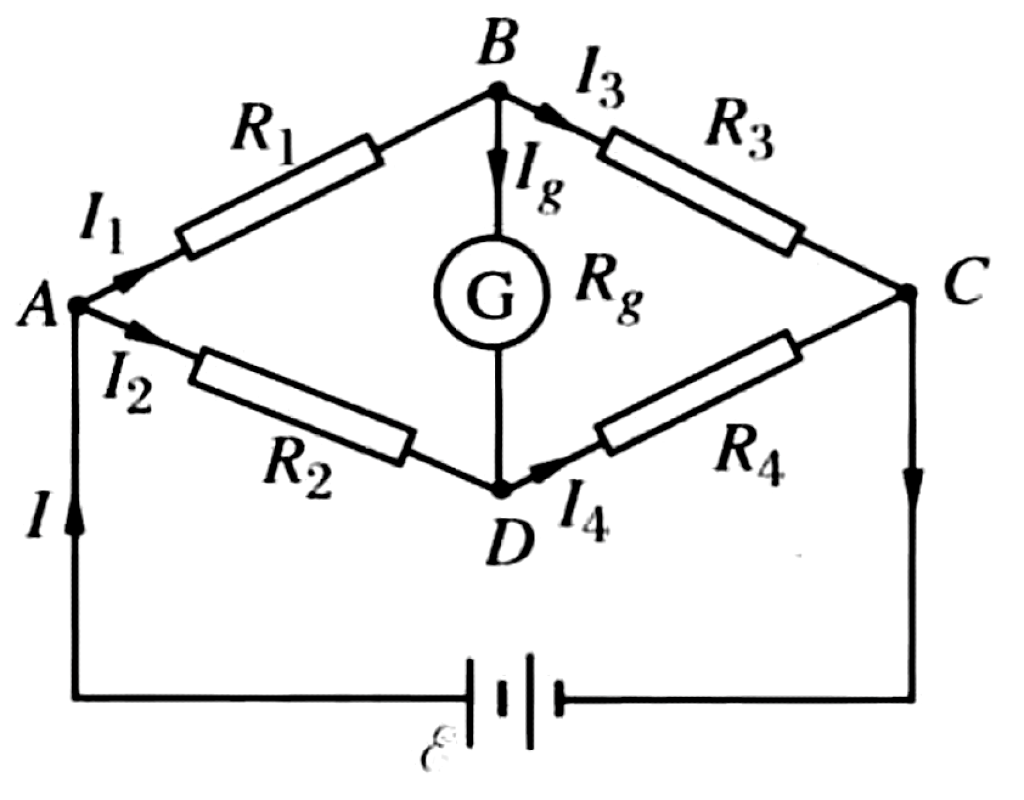
A Wheatstone bridge consists of four arm resistors $R_1, R_2, R_3, R_4$ and a galvanometer G with internal resistance $R_g$ connecting the two bridge nodes. An EMF $\varepsilon$ drives the bridge. Currents $I_1, I_2, I_3, I_4$ flow through the four arms, and $I_g$ flows through the galvanometer. Write Kirchhoff's equations relating the arm currents to the galvanometer current and the EMF.
- Given $\varepsilon = 6$ V, $R_1 = 100$ $\Omega$, $R_2 = 200$ $\Omega$, $R_3 = 300$ $\Omega$, $R_4 = 400$ $\Omega$, and $R_g = 500$ $\Omega$, find $I_1, I_2, I_3, I_4$, and $I_g$.
- Prove that when the arm resistances satisfy $R_1/R_2 = R_3/R_4$, the galvanometer current $I_g = 0$. (This is the balanced-bridge condition.)
(1) $I_g \approx 0.71$ mA, $I_1 \approx 15.5$ mA, $I_2 \approx 9.5$ mA, $I_3 \approx 14.8$ mA, $I_4 \approx 10.2$ mA. (2) When $R_1/R_2 = R_3/R_4$, setting $I_g = 0$ satisfies all Kirchhoff equations; this is the balanced-bridge condition.
Label nodes A (source +), B and D (bridge nodes), C (source $-$). Arms: $R_1$ on A-B, $R_2$ on A-D, $R_3$ on B-C, $R_4$ on D-C, $R_g$ (galvanometer) on B-D with $I_g$ defined from B to D.
KCL: $I = I_1 + I_2$ at A; $I_1 = I_3 + I_g$ at B; $I_2 + I_g = I_4$ at D.
KVL loops: Loop ABDA: $I_1 R_1 + I_g R_g - I_2 R_2 = 0$. Loop BCDB: $I_3 R_3 - I_4 R_4 - I_g R_g = 0$. Source loop ABC: $\varepsilon = I_1 R_1 + I_3 R_3$.
(1) Substitute $I_3 = I_1 - I_g$, $I_4 = I_2 + I_g$ into the bridge KVLs. After dividing by 100, get $I_1 - 2 I_2 = -5 I_g$ (from ABDA) and $3 I_1 - 4 I_2 = 12 I_g$ (from BCDB). Solving the pair: $I_2 = 13.5 I_g$, $I_1 = 22 I_g$. Substituting into the source equation (with currents in mA, since $\varepsilon = 6$ V = 6000 mV and resistances in $\Omega$): $100(22 I_g) + 300(21 I_g) = 6000$ mV, so $8500 I_g = 6000$ mV, hence $I_g = 12/17$ mA $\approx 0.71$ mA. Then $I_1 \approx 15.5$ mA, $I_2 \approx 9.5$ mA, $I_3 = I_1 - I_g \approx 14.8$ mA, $I_4 = I_2 + I_g \approx 10.2$ mA.
(2) Setting $I_g = 0$ in the KCLs gives $I_1 = I_3$ and $I_2 = I_4$. Substituting into the two bridge KVL equations: $I_1 R_1 = I_2 R_2$ and $I_1 R_3 = I_2 R_4$. Dividing the second by the first: $R_3/R_1 = R_4/R_2$, equivalently $R_1/R_2 = R_3/R_4$. Thus whenever this condition holds, $I_g = 0$ is a consistent solution of all Kirchhoff equations, and no current flows through the galvanometer.