Source: High school physics (Chinese)
Problem Sets:
Problem
A circuit consists of three branches in parallel between two nodes. The top branch (in series): EMF $\varepsilon_1 = 1.0$ V with internal resistance $r_1 = 1.0$ $\Omega$, resistor $R_1 = 1.0$ $\Omega$, and EMF $\varepsilon_3 = 3.0$ V with internal resistance $r_3 = 1.0$ $\Omega$. The middle branch: EMF $\varepsilon_2 = 2.0$ V with internal resistance $r_2 = 1.0$ $\Omega$. The bottom branch: $R_2 = 3.0$ $\Omega$. All EMFs are oriented to drive current across the parallel combination in the same direction.
- Find the current through $\varepsilon_3$.
- Find the power dissipated in $R_2$.
- Find the power delivered by $\varepsilon_3$ to the external circuit.
- Find the total rate of heat generation in the circuit.
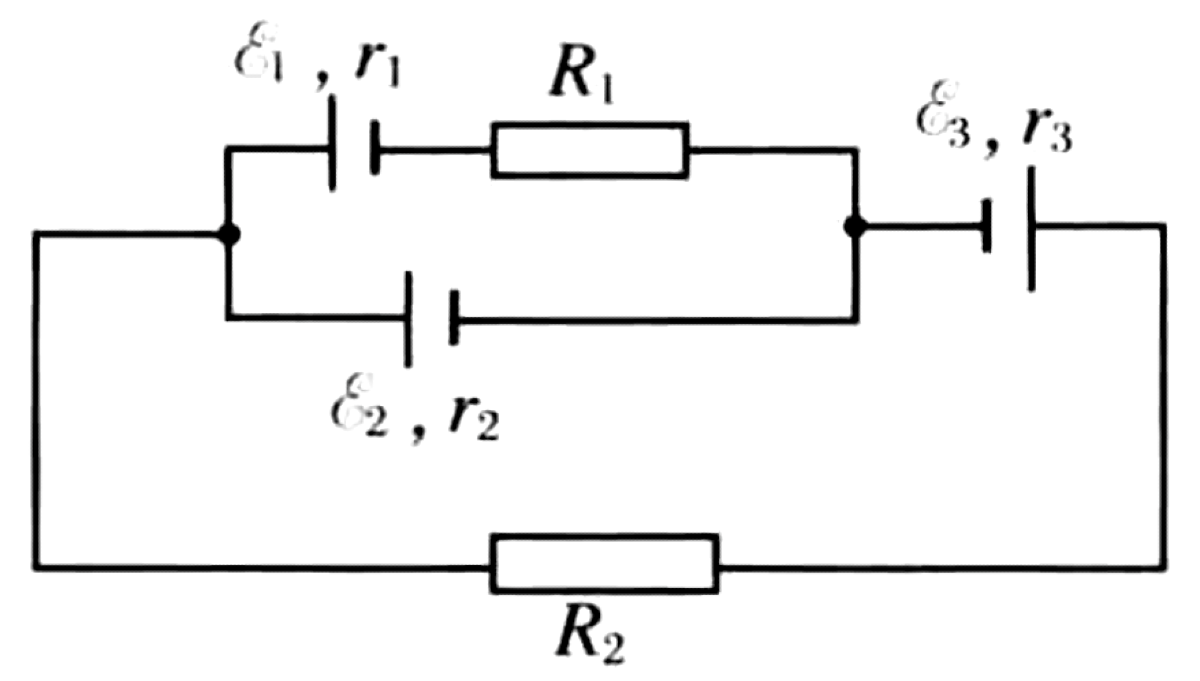
(1) $I_{\varepsilon_3} = 2/3$ A $\approx 0.67$ A. (2) $P_{R_2} = 4/3$ W $\approx 1.33$ W. (3) $P_{\varepsilon_3} = 14/9$ W $\approx 1.56$ W. (4) $P_{heat} = 8/3$ W $\approx 2.67$ W.
Let $U = V_P - V_Q$ between the two nodes. Define branch currents flowing $P \to Q$.
Top branch: $I_1 = (U + \varepsilon_1 + \varepsilon_3)/(r_1 + R_1 + r_3) = (U + 4)/3$. Middle branch: $I_2 = (U + \varepsilon_2)/r_2 = U + 2$. Bottom branch: $I_3 = U/R_2 = U/3$.
KCL: $I_1 + I_2 + I_3 = 0 \Rightarrow (U + 4)/3 + (U + 2) + U/3 = 0 \Rightarrow 5U + 10 = 0 \Rightarrow U = -2$ V.
Thus $I_1 = 2/3$ A, $I_2 = 0$, $I_3 = -2/3$ A (i.e., 2/3 A flows from $Q$ to $P$ through $R_2$).
(2) $P_{R_2} = I_3^2 R_2 = (2/3)^2 \cdot 3 = 4/3$ W.
(3) Terminal voltage of $\varepsilon_3$: $U_3 = \varepsilon_3 - I_1 r_3 = 3 - 2/3 = 7/3$ V. External power supplied: $P_{\varepsilon_3} = U_3 I_1 = (7/3)(2/3) = 14/9$ W.
(4) Total heat rate: $P_{heat} = I_1^2(r_1 + R_1 + r_3) + I_2^2 r_2 + I_3^2 R_2 = (4/9)(3) + 0 + (4/9)(3) = 8/3$ W. Check via total EMF power: $\varepsilon_1 I_1 + \varepsilon_3 I_1 + \varepsilon_2 I_2 = 1(2/3) + 3(2/3) + 0 = 8/3$ W.