Source: High school physics (Chinese)
Problem Sets:
Problem
In the circuit shown, the internal resistances of both battery groups and the ammeter can be neglected. The circuit contains a 12 V battery, a 2 V battery, three 2 $\Omega$ resistors, and an ammeter A.
- Find the current through the ammeter.
- Find the energy output by the 12 V battery in 3 s.
- Find the total heat generated in this time. Why are the results of (2) and (3) different?
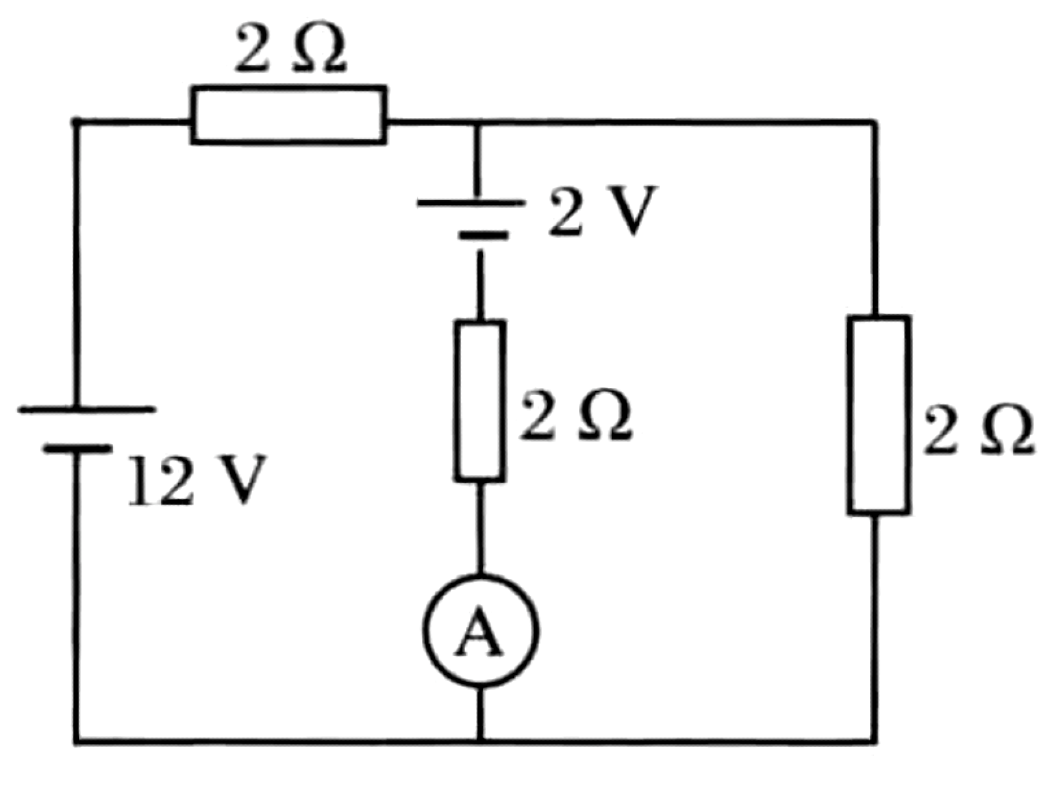
(1) $I_A = 4/3$ A $\approx 1.33$ A. (2) $W_{12} = 132$ J. (3) $Q = 124$ J; the 8 J difference is the energy used to charge the 2 V battery.
Apply Kirchhoff's laws. Let $I$ be the current through the 12 V battery, $I_A$ the ammeter reading, and $I_R$ the current through the right 2 $\Omega$ resistor. KCL gives $I = I_A + I_R$.
KVL around the outer loop (12 V and right 2 $\Omega$): $12 = 2I + 2I_R$. KVL around the left loop (12 V and middle branch, with the 2 V battery being charged): $12 = 2I + 2I_A + 2$.
Solving: $I = 11/3$ A, $I_A = 4/3$ A, $I_R = 7/3$ A.
(2) Energy from 12 V battery: $W_{12} = \varepsilon I t = 12 \times (11/3) \times 3 = 132$ J.
(3) Total heat in resistors: $Q = (I^2 + I_A^2 + I_R^2) \cdot R \cdot t = [(121 + 16 + 49)/9] \cdot 2 \cdot 3 = 124$ J. The 8 J difference equals the energy absorbed by the 2 V battery being charged: $W_2 = \varepsilon_2 I_A t = 2 \times (4/3) \times 3 = 8$ J. Energy is conserved: $W_{12} = Q + W_2$.