Source: High school physics (Chinese)
Problem Sets:
Problem
An ohmmeter directly measures resistance and is usually a component of a multimeter. Its construction is shown in figure 13.34(a) and includes a galvanometer, a power source, and a variable resistor. When the red and black probes touch directly, the variable resistor is adjusted so that the galvanometer needle reaches full-scale deflection. The current at this moment is
$$I=\frac{\mathcal{E}}{r+R_g+R},$$where $\mathcal{E}$ is the EMF of the source, $r$ is the source's internal resistance, $R_g$ is the galvanometer's internal resistance, and $R$ is the adjusted value of the variable resistor. The sum $(r+R_g+R)$ is called the total internal resistance of the ohmmeter, $R_{\text{total}}$. When the resistance between the probes is zero, the needle points to full scale; when the probes are separated (resistance infinite), $I=0$ and the needle points to zero. When an unknown resistance $R_x$ is connected between the probes,
$$I=\frac{\mathcal{E}}{R_{\text{total}}+R_x}.$$For a fixed $R_{\text{total}}$, every $R_x$ corresponds to a unique $I$, so resistance values can be marked directly on the galvanometer's scale.
Suppose the scale of a particular ohmmeter is as shown in figure 13.34(b), where arc $AB$ is centered on the needle's pivot. When the probes are separated, the needle points to $A$; when they touch, the needle points to $B$. Point $C$ is the midpoint of arc $AB$; $D$ is the midpoint of arc $AC$; $E$ is the midpoint of arc $AD$; and $F$ is the midpoint of arc $CB$. The total internal resistance is $R_{\text{total}}=4.8\ \text{k}\Omega$, and the galvanometer's deflection angle is proportional to the current (so the current scale is uniform).
- What resistance values do points $A$, $B$, $C$, $D$, $E$, $F$ represent?
- Is the resistance scale on the dial uniform?
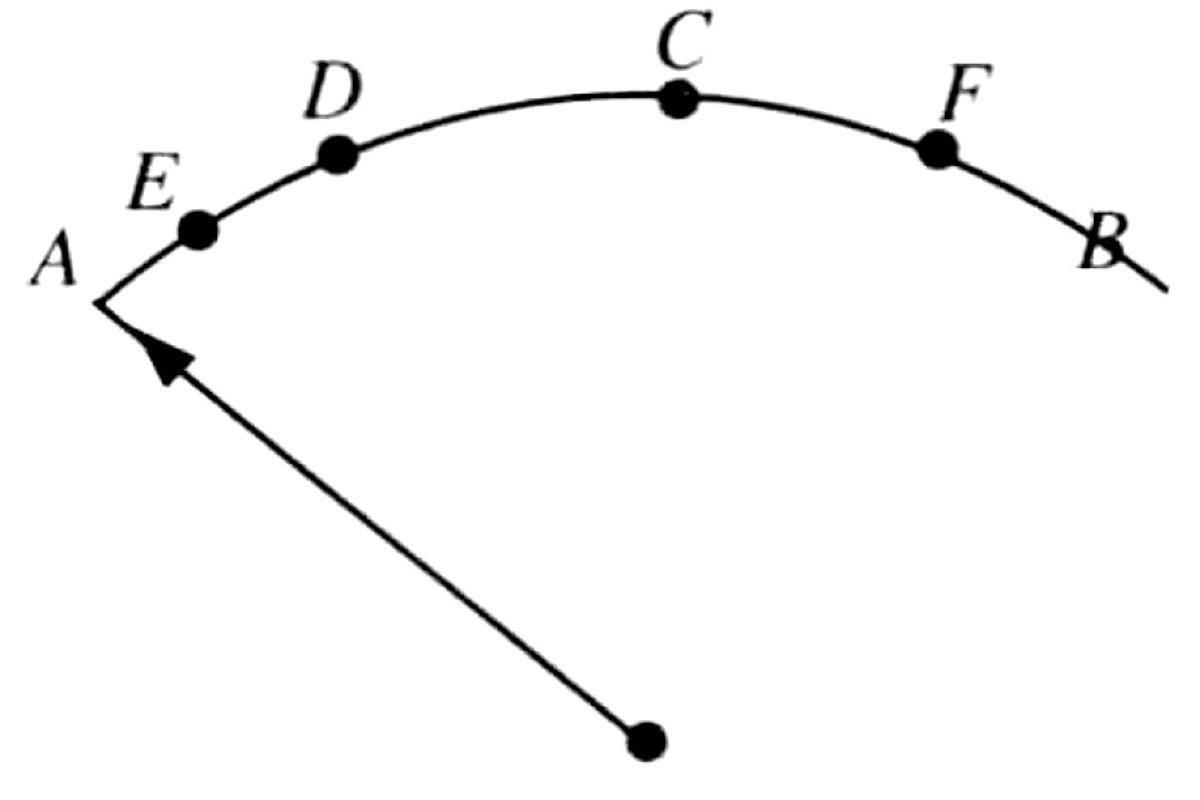
Let $I_{\max}=\mathcal{E}/R_{\text{total}}$ be the full-scale current. For a general point with current $I$,
$$\frac{I}{I_{\max}}=\frac{R_{\text{total}}}{R_{\text{total}}+R_x}\ \Longrightarrow\ R_x=R_{\text{total}}\left(\frac{I_{\max}}{I}-1\right)=R_{\text{total}}\,\frac{I_{\max}-I}{I}.$$Because the deflection angle (geometric position along the arc) is proportional to the current, the fractional position of each point on arc $AB$ equals $I/I_{\max}$:
$A$: position $0$, so $I=0$ and $R_x\to\infty$. $B$: position $1$, so $I=I_{\max}$ and $R_x=0$. $C$ (midpoint of $AB$): position $1/2$, so $I=I_{\max}/2$ and $$R_x=R_{\text{total}}\cdot\frac{1/2}{1/2}=R_{\text{total}}=4.8\ \text{k}\Omega.$$ $D$ (midpoint of $AC$): position $1/4$, so $I=I_{\max}/4$ and $$R_x=R_{\text{total}}\cdot\frac{3/4}{1/4}=3R_{\text{total}}=14.4\ \text{k}\Omega.$$ $E$ (midpoint of $AD$): position $1/8$, so $I=I_{\max}/8$ and $$R_x=R_{\text{total}}\cdot\frac{7/8}{1/8}=7R_{\text{total}}=33.6\ \text{k}\Omega.$$ $F$ (midpoint of $CB$): position $3/4$, so $I=3I_{\max}/4$ and $$R_x=R_{\text{total}}\cdot\frac{1/4}{3/4}=\tfrac{1}{3}R_{\text{total}}=1.6\ \text{k}\Omega.$$The current scale is uniform, but the map $R_x=R_{\text{total}}(I_{\max}-I)/I$ from $I$ to $R_x$ is nonlinear. Equal angular (current) intervals therefore correspond to unequal resistance intervals: resistance markings are crowded near $B$ (small $R_x$) and stretched out toward $A$ (large $R_x$), with $R_x=\infty$ collapsed onto the single point $A$. The resistance scale is not uniform.