Source: High school physics (Chinese)
Problem Sets:
Problem
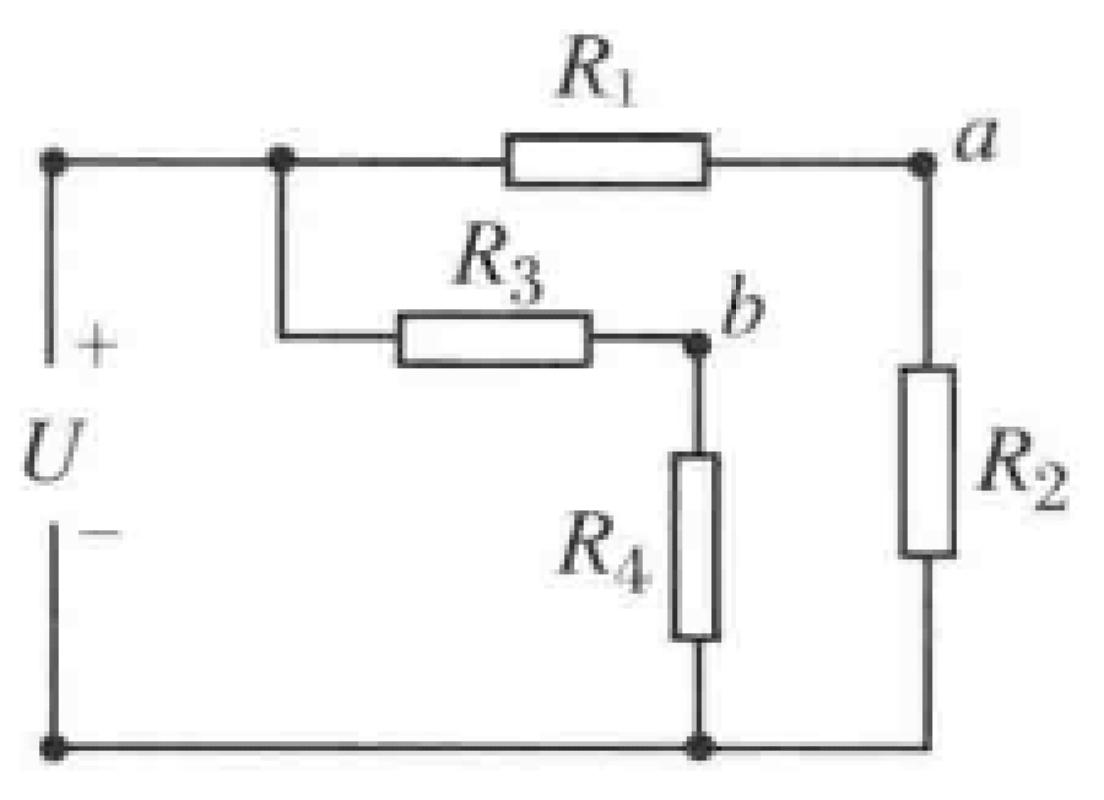
In the circuit shown, a source of EMF $U = 3.0$ V drives two parallel branches. One branch has $R_1$ in series with $R_2$, with point $a$ at the node between them. The other branch has $R_3$ in series with $R_4$, with point $b$ at the node between them. Given $R_1 = R_2$.
- Find the voltage $U_{ab}$ when $R_3 = R_4$.
- Find $U_{ab}$ when $R_3 = 2R_4$.
- Find $U_{ab}$ when $R_3 = R_4/2$.
(1) $U_{ab} = 0$.\ (2) $U_{ab} = 0.5$ V ($a$ at higher potential).\ (3) $U_{ab} = -0.5$ V ($b$ at higher potential).
Treating each branch as an independent voltage divider with the negative terminal of $U$ as the reference:
$$V_a = U \cdot \frac{R_2}{R_1 + R_2}, \qquad V_b = U \cdot \frac{R_4}{R_3 + R_4}.$$With $R_1 = R_2$, $V_a = U/2 = 1.5$ V regardless of the case. Then $U_{ab} = V_a - V_b$.
(1) $R_3 = R_4$: $V_b = U/2 = 1.5$ V, so $U_{ab} = 0$.
(2) $R_3 = 2R_4$: $V_b = U \cdot \dfrac{R_4}{3R_4} = U/3 = 1$ V, so $U_{ab} = 1.5 - 1 = 0.5$ V.
(3) $R_3 = R_4/2$: $V_b = U \cdot \dfrac{R_4}{(3/2)R_4} = 2U/3 = 2$ V, so $U_{ab} = 1.5 - 2 = -0.5$ V.