Source: High school physics (Chinese)
Problem Sets:
Problem
In the circuit shown, $R_1$ and $R_3$ are connected in parallel between the positive terminal of the supply and a middle node; $R_2$ and $R_4$ are connected in parallel between that middle node and the negative terminal. The supply voltage is $U = 6.0$ V. Given $R_1 = 10$ k$\Omega$, $R_2 = 5.0$ k$\Omega$, $R_3 = 2.0$ k$\Omega$, $R_4 = 1.0$ k$\Omega$.
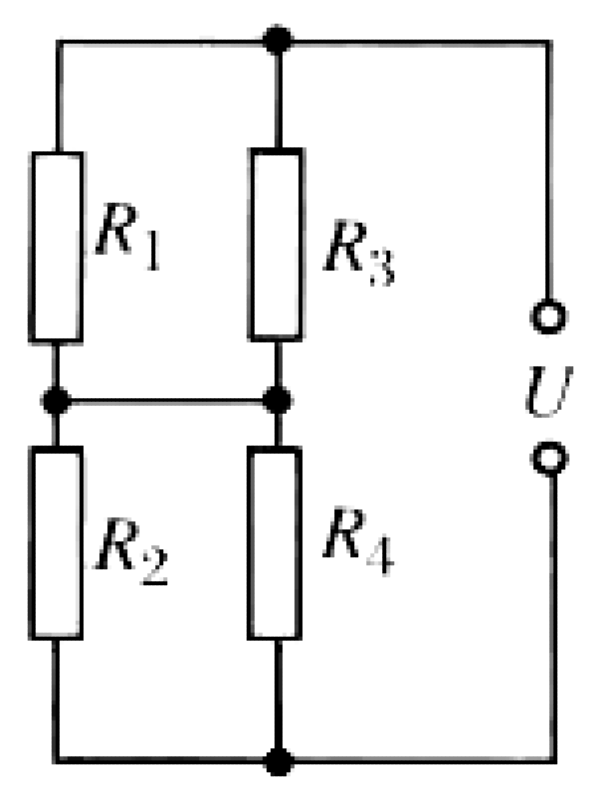
Top parallel combination: $R_{13} = \dfrac{R_1 R_3}{R_1 + R_3} = \dfrac{10 \times 2}{12} = \dfrac{5}{3}$ k$\Omega$.
Bottom parallel combination: $R_{24} = \dfrac{R_2 R_4}{R_2 + R_4} = \dfrac{5 \times 1}{6} = \dfrac{5}{6}$ k$\Omega$.
Total: $R_\text{tot} = R_{13} + R_{24} = \dfrac{5}{3} + \dfrac{5}{6} = \dfrac{5}{2}$ k$\Omega$.
Total current: $I = U/R_\text{tot} = 6/(5/2) = 2.4$ mA. Voltage across the top pair:
$$U_\text{top} = I R_{13} = 2.4 \times \frac{5}{3} = 4 \text{ V}.$$Current through $R_3$: $I_3 = U_\text{top}/R_3 = 4/2 = 2$ mA.