Source: High school physics (Chinese)
Problem Sets:
Problem
In the circuit shown, $R_1$, $R_2$, and $R_3$ are connected in series across the supply $U$. $R_2$ is a rheostat with slider $P$. Point $a$ is taken at the slider $P$, and point $b$ is at the node between $R_3$ and the negative terminal of the supply. Given $R_1 = 350\ \Omega$, $R_2 = 270\ \Omega$, $R_3 = 550\ \Omega$, and $U = 12$ V.
- As slider $P$ moves upward from the bottom end of $R_2$, how does the voltage $U_{ab}$ change?
- What is $U_{ab}$ when $P$ is at the bottom end of $R_2$, and when $P$ is at the top end of $R_2$?
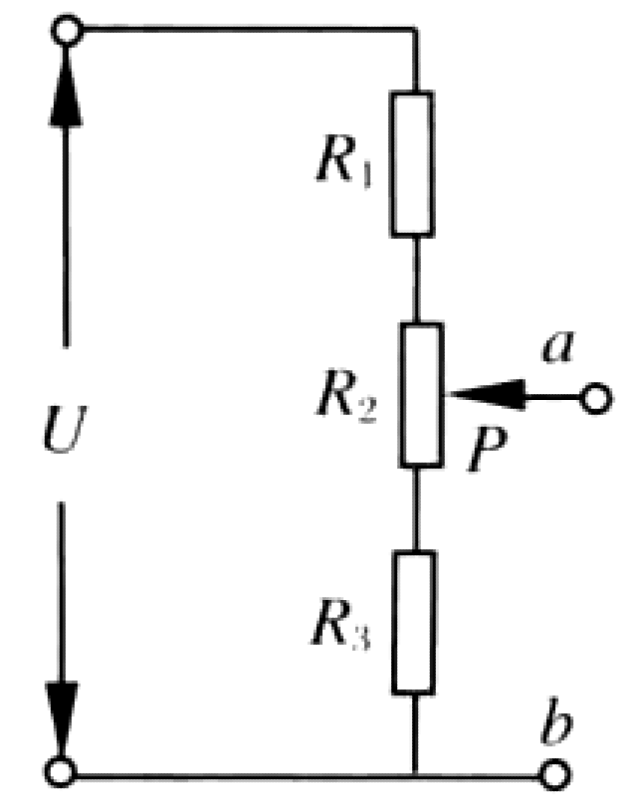
The slider is only a voltage tap (no external current), so the loop current is constant:
$$I = \frac{U}{R_1 + R_2 + R_3} = \frac{12}{1170}\ \text{A}.$$Let $R'$ be the portion of $R_2$ below the slider. Going from $a$ (the slider) downward through $R'$ and then through $R_3$ to $b$:
$$U_{ab} = I (R' + R_3).$$As $P$ moves up, $R'$ grows from $0$ to $R_2$, so $U_{ab}$ increases monotonically.
When $P$ is at the bottom of $R_2$, $R' = 0$:
$$U_{ab} = I R_3 = \frac{12 \times 550}{1170} = \frac{220}{39} \approx 5.64 \text{ V}.$$When $P$ is at the top of $R_2$, $R' = R_2$:
$$U_{ab} = I (R_2 + R_3) = \frac{12 \times 820}{1170} = \frac{328}{39} \approx 8.41 \text{ V}.$$