Source: High school physics (Chinese)
Problem Sets:
Problem
To measure the current in a circuit, the circuit must be broken and an ammeter inserted in series, as shown. The circuit consists of a battery (emf $\varepsilon$, negligible internal resistance) connected to two resistors $R_1$ and $R_2$ in series. The ammeter has non-zero internal resistance $R_A$.
- After the ammeter is inserted into the circuit, does the current in the original circuit change?
- Is the current value read by the ammeter equal to the original current being measured? Does it become larger or smaller?
- Under what condition is the measurement most accurate?
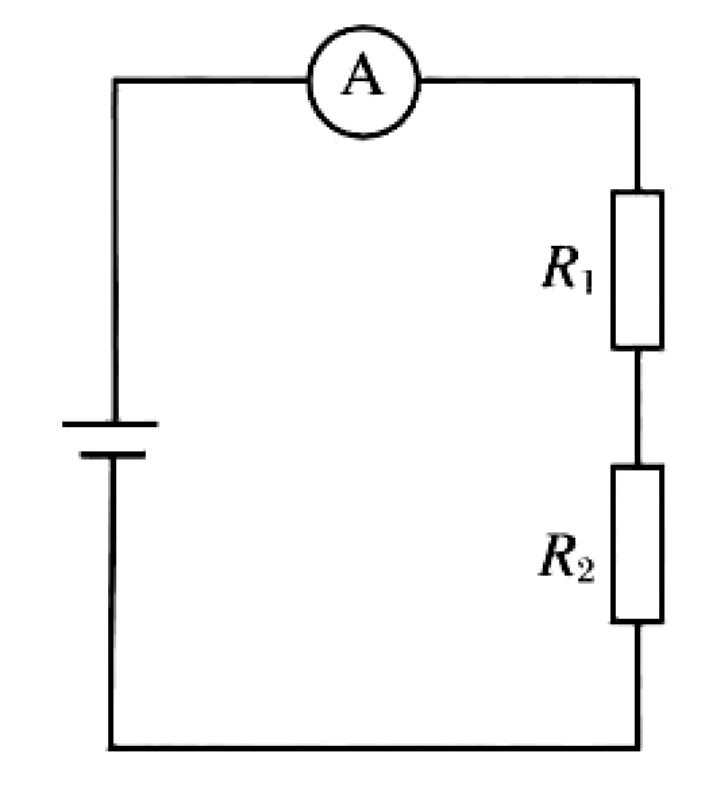
(1) Yes — the original current is changed (reduced). (2) The reading is smaller than the original current to be measured. (3) When $R_A \ll R_1 + R_2$ (ammeter internal resistance much smaller than the circuit resistance).
Before inserting the ammeter, the original circuit current is
$$I_0 = \frac{\varepsilon}{R_1 + R_2}.$$After inserting the ammeter (internal resistance $R_A$) in series, the total resistance increases to $R_1 + R_2 + R_A$, so the current becomes
$$I = \frac{\varepsilon}{R_1 + R_2 + R_A}.$$(1) Since $R_A > 0$, we have $I < I_0$: inserting the ammeter reduces the circuit current, so it does change the original current.
(2) The ammeter reads the new (reduced) current $I$, not the original $I_0$. The reading is smaller than the value being measured.
(3) The fractional error is
$$\frac{I_0 - I}{I_0} = \frac{R_A}{R_1 + R_2 + R_A}.$$This is minimized when $R_A \ll R_1 + R_2$: the ammeter's internal resistance must be much smaller than the rest of the circuit's resistance. An ideal ammeter has $R_A \to 0$.