Source: High school physics (Chinese)
Problem Sets:
Problem
To measure the voltage between two points $A$ and $B$ in a circuit, a voltmeter is connected in parallel across those two points, as shown in Figure. The circuit consists of a battery with resistors $R_1$ and $R_2$ in series, and the voltmeter is placed across $R_2$ (between $A$ and $B$). The voltmeter's internal resistance $R_V$ is finite (not infinite).
- After the voltmeter is connected, does the original distribution of current and voltage in the circuit change?
- Is the reading on the voltmeter equal to the voltage originally across $AB$? Is it larger or smaller?
- Under what condition is the measurement more accurate?
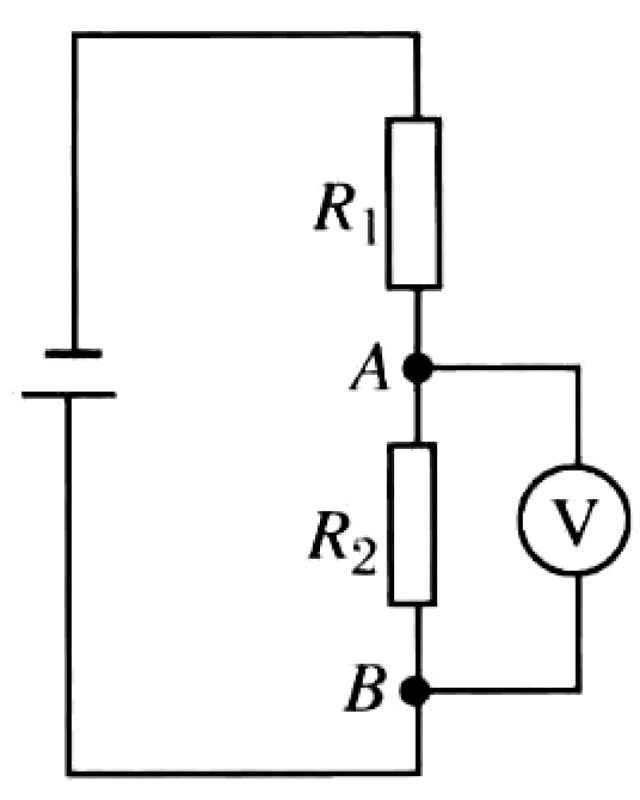
(1) Yes; the finite voltmeter resistance lowers $R_{AB}$, redistributing current and voltage in the circuit.
(2) The reading is smaller than the original voltage $V_{AB}$.
(3) The measurement is accurate when $R_V\gg R_2$ (voltmeter internal resistance much greater than the resistance of the section being measured).
With $R_V$ in parallel with $R_2$, the equivalent resistance between $A$ and $B$ is
$$R_{AB}'=\frac{R_2 R_V}{R_2+R_V}The voltmeter reads $V_{AB}'=I'R_{AB}'$. Since the share of EMF taken by $AB$ falls, $V_{AB}' The error vanishes in the limit $R_V\gg R_2$, where $R_{AB}'\to R_2$ and the circuit is barely perturbed.