Source: High school physics (Chinese)
Problem
In the circuit in the Figure, $C_1 = 10\ \mu\mathrm{F}$, $C_2 = 5\ \mu\mathrm{F}$, and $C_3 = 5\ \mu\mathrm{F}$. $C_1$ and $C_2$ are connected in parallel between terminal $A$ and a middle node; that parallel combination is in series with $C_3$ from the middle node to terminal $B$.
- Find the equivalent capacitance between terminals $A$ and $B$.
- If a voltage of $100$ V is applied between $A$ and $B$, find the charge and voltage on $C_2$.
- Suppose $C_1$ is suddenly broken down (short-circuited) while the $100$ V is still applied. What are the charge and voltage on $C_3$ after the short occurs?
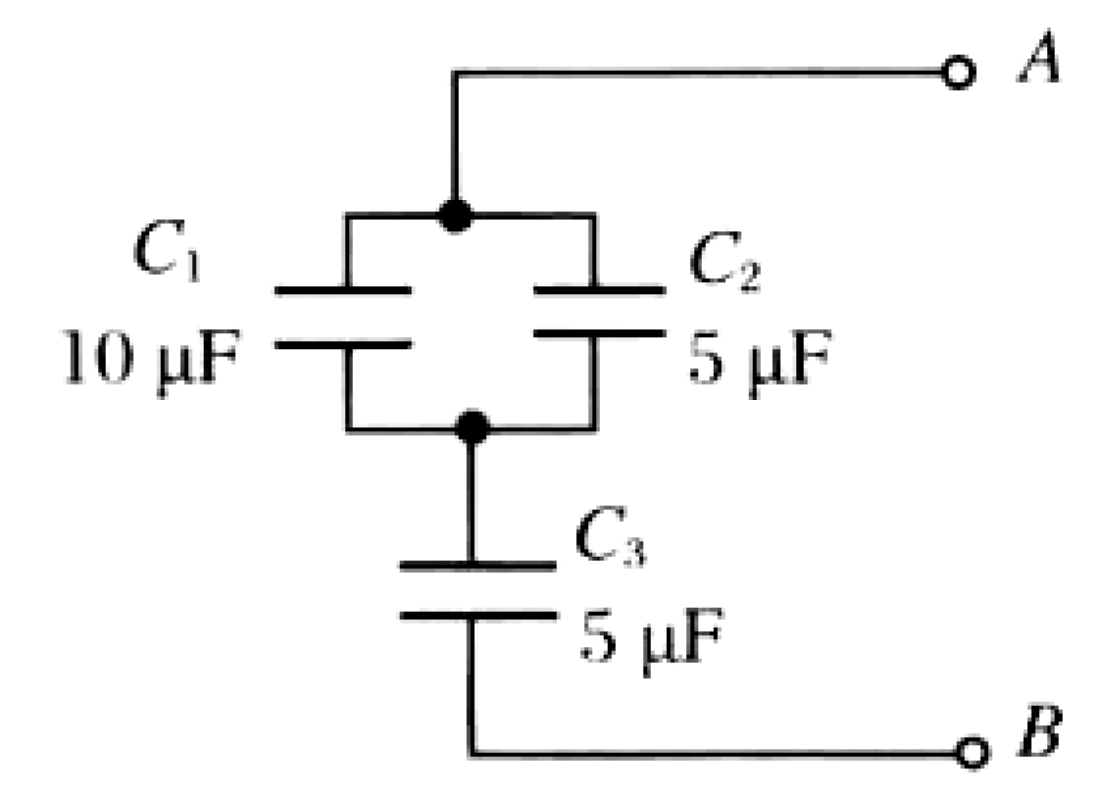
(1) $C_{AB} = 3.75\ \mu\mathrm{F}$. (2) $Q_{C_2} = 125\ \mu\mathrm{C}$, $V_{C_2} = 25$ V. (3) $Q_{C_3} = 500\ \mu\mathrm{C}$, $V_{C_3} = 100$ V.
(1) Parallel combination: $C_{12} = C_1 + C_2 = 15\ \mu\mathrm{F}$. In series with $C_3$:
$$\dfrac{1}{C_{AB}} = \dfrac{1}{C_{12}} + \dfrac{1}{C_3} = \dfrac{1}{15} + \dfrac{1}{5} = \dfrac{4}{15} \;\Longrightarrow\; C_{AB} = \dfrac{15}{4} = 3.75\ \mu\mathrm{F}.$$(2) Total charge on the series combination at $100$ V: $Q = C_{AB} U = 3.75 \times 100 = 375\ \mu\mathrm{C}$. This charge sits on $C_3$ and on the $C_{12}$ block as a whole. So
$$V_{C_3} = \dfrac{Q}{C_3} = \dfrac{375}{5} = 75\ \mathrm{V}, \qquad V_{C_{12}} = U - V_{C_3} = 100 - 75 = 25\ \mathrm{V}.$$Within the parallel block, $C_2$ shares the same voltage as $C_1$:
$$V_{C_2} = 25\ \mathrm{V}, \qquad Q_{C_2} = C_2 V_{C_2} = 5 \times 25 = 125\ \mu\mathrm{C}.$$(3) When $C_1$ breaks down, it becomes a wire (short circuit). The parallel block $C_{12}$ collapses to a short (any capacitor in parallel with a wire has zero net voltage across it), so the full $100$ V appears across $C_3$:
$$V_{C_3} = 100\ \mathrm{V}, \qquad Q_{C_3} = C_3 V_{C_3} = 5 \times 100 = 500\ \mu\mathrm{C}.$$