Source: High school physics (Chinese)
Problem
A charged particle of mass $m = 5 \times 10^{-8}$ kg enters horizontally at the central midline between two horizontal parallel metal plates $A$ (top) and $B$ (bottom) with initial speed $v_0 = 2$ m/s. The plate length is $l = 0.1$ m and the plate separation is $d = 2 \times 10^{-2}$ m. When $U_{AB} = 1000$ V, the particle traverses the field along a straight horizontal line. Take $g = 10\ \mathrm{m/s^2}$.
- Determine the sign and magnitude of the particle's charge.
- If the potential difference $U_{AB}$ is adjustable, what range of $U_{AB}$ allows the particle to exit between the plates without striking either plate?
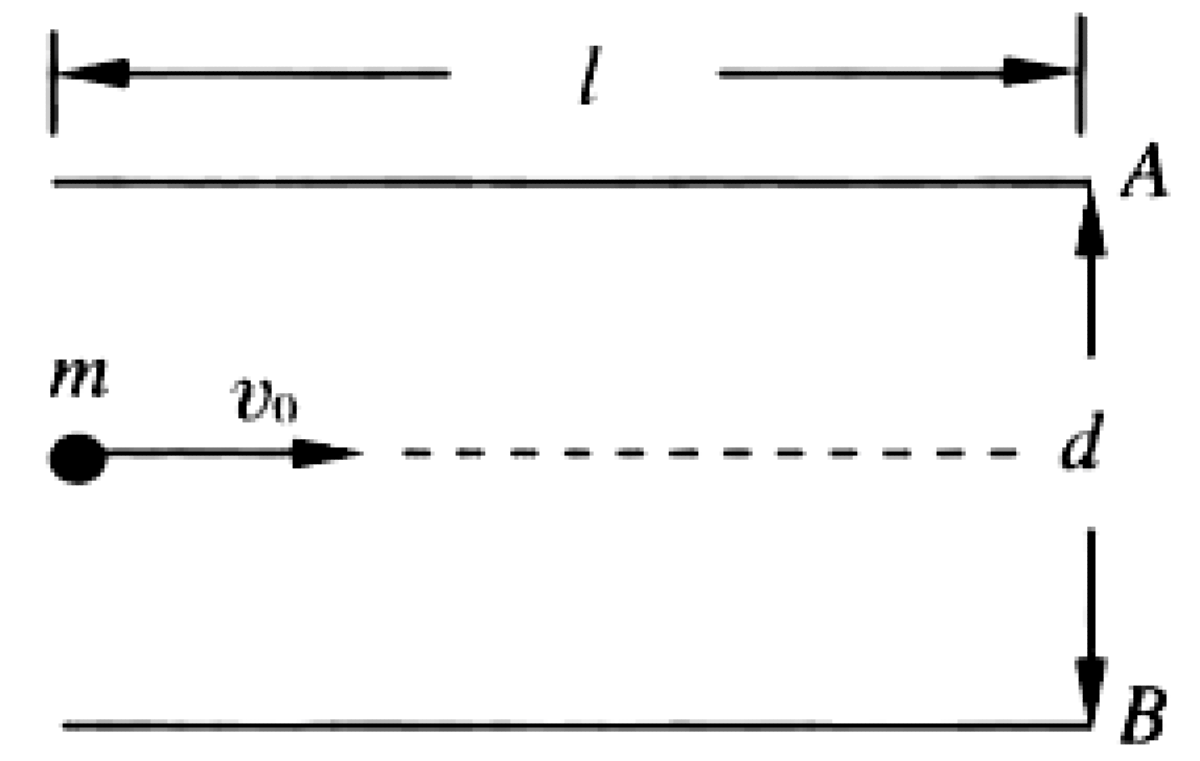
(1) Negative charge of magnitude $|q| = 10^{-11}$ C. (2) $200\ \mathrm{V} \le U_{AB} \le 1800\ \mathrm{V}$.
At $U_{AB} = 1000$ V, the field between the plates is $E = U_{AB}/d = 1000/(2 \times 10^{-2}) = 5 \times 10^{4}$ V/m, directed downward (from $A$ at higher potential to $B$). For the particle to remain horizontal, the electric force must point upward and exactly cancel gravity, so the particle is \emph{negatively} charged. Its magnitude:
$$|q| E = mg \;\Longrightarrow\; |q| = \dfrac{mg}{E} = \dfrac{(5 \times 10^{-8})(10)}{5 \times 10^{4}} = 10^{-11}\ \mathrm{C}.$$For general $U_{AB} = U$, take downward as positive. The vertical acceleration is
$$a_y = g - \dfrac{|q|U}{m d} = 10 - 0.01\, U \quad (\mathrm{m/s^2}).$$Time of flight: $t = l/v_0 = 0.05$ s. Vertical displacement:
$$y = \tfrac{1}{2} a_y t^2 = \tfrac{1}{2} (10 - 0.01 U)(0.05)^2 = 0.0125 - 1.25 \times 10^{-5}\, U \quad (\mathrm{m}).$$To exit, the particle's vertical displacement must satisfy $|y| \le d/2 = 0.01$ m (otherwise it hits a plate):
$$-0.01 \le 0.0125 - 1.25 \times 10^{-5}\, U \le 0.01.$$Solving: $200 \le U \le 1800$ V.
Boundary check: at $U = 200$ V, $y = 0.01$ m (particle just grazes plate $B$); at $U = 1800$ V, $y = -0.01$ m (particle just grazes plate $A$).