Source: High school physics (Chinese)
Problem
As shown, an electron enters a uniform electric field at point $A$ with velocity $v_0 = 10^{6}$ m/s, directed perpendicular to the field. The electron exits at point $B$ with its velocity at an angle of $30^\circ$ relative to the entry direction. The electron has charge $e = 1.6 \times 10^{-19}$ C and mass $m = 9.1 \times 10^{-31}$ kg.
- Find the kinetic energy of the electron at point $B$.
- Find the potential difference $U_{AB}$ between points $A$ and $B$.
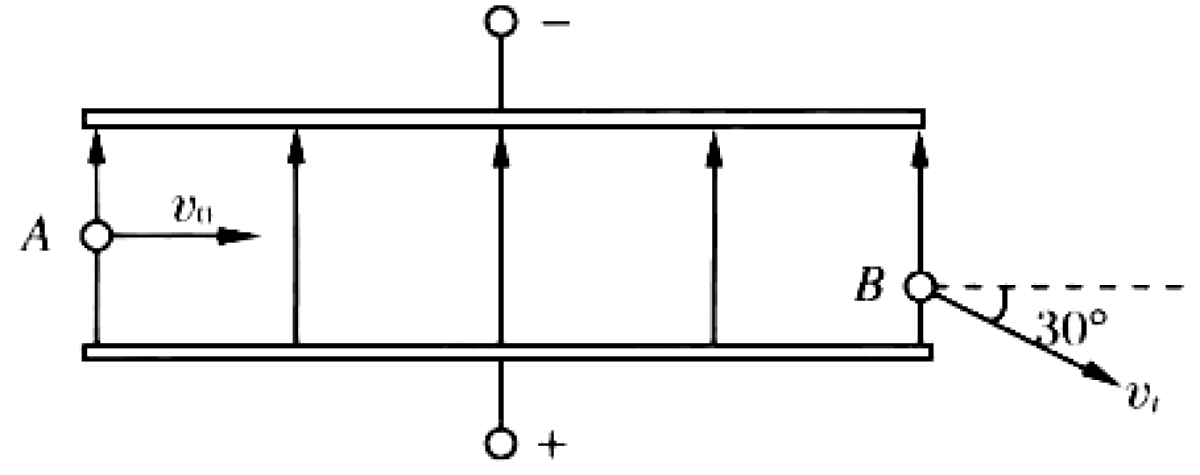
The horizontal velocity is unchanged by the perpendicular field, $v_x = v_0$. The exit velocity makes angle $30^\circ$ with the horizontal, so the total speed at $B$ satisfies $v_B = v_0 / \cos 30^\circ$.
(1) Kinetic energy at $B$:
$$KE_B = \tfrac{1}{2} m v_B^2 = \dfrac{\tfrac{1}{2} m v_0^2}{\cos^2 30^\circ} = \dfrac{KE_A}{3/4} = \dfrac{4}{3} KE_A.$$With $KE_A = \tfrac{1}{2} (9.1 \times 10^{-31})(10^{6})^2 = 4.55 \times 10^{-19}$ J:
$$KE_B = \dfrac{4}{3} \times 4.55 \times 10^{-19} \approx 6.07 \times 10^{-19}\ \mathrm{J}.$$(2) By the work--energy theorem, the work done by the electric force as the electron travels from $A$ to $B$ equals the gain in kinetic energy:
$$W_{AB} = q (V_A - V_B) = (-e) U_{AB} = KE_B - KE_A.$$So
$$U_{AB} = -\dfrac{KE_B - KE_A}{e} = -\dfrac{\tfrac{1}{3} KE_A}{e} = -\dfrac{4.55 \times 10^{-19} / 3}{1.6 \times 10^{-19}} \approx -0.95\ \mathrm{V}.$$ $U_{AB} < 0$ means $V_B > V_A$: the electron travels from lower potential to higher potential, consistent with its gain in kinetic energy.