Source: High school physics (Chinese)
Problem
Three small balls of equal mass --- one positively charged, one negatively charged, and one uncharged --- are launched with the same velocity from point $P$ between two charged horizontal parallel plates, perpendicular to the electric field direction. The upper plate is negative and the lower plate is positive. The three balls land at points $A$, $B$, $C$ on the positive (lower) plate, with $A$ being the farthest horizontal distance from $P$, then $B$, then $C$ (closest to $P$). Gravity is included.
- Which ball is positively charged? Which is negatively charged?
- Are the times of flight in the field equal for the three balls? Are their kinetic energies upon reaching the positive plate equal? If not equal, which is greatest and which is least?
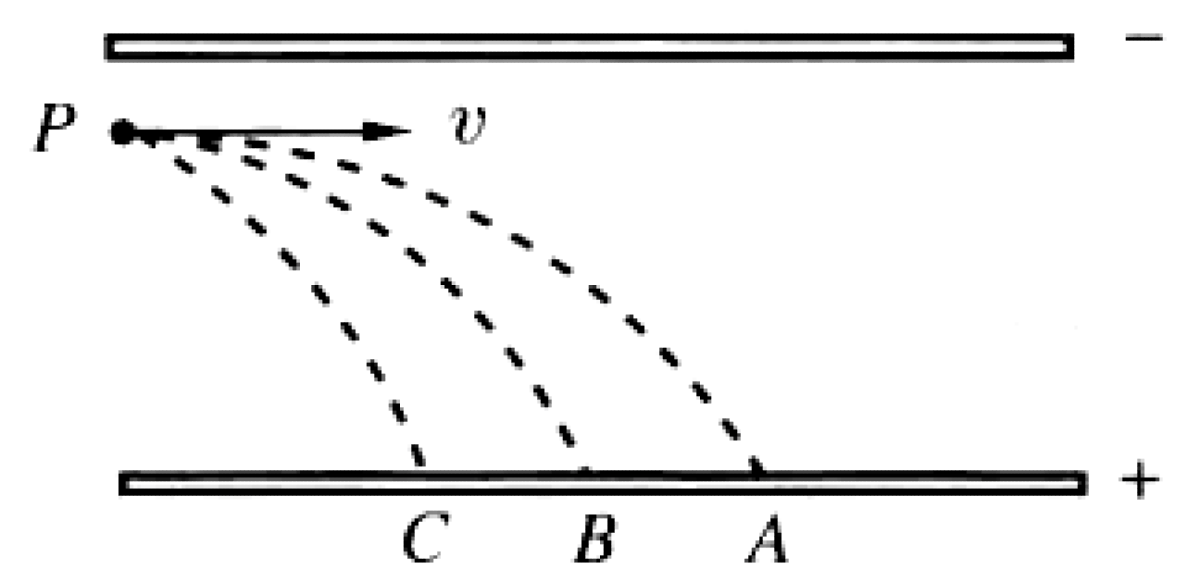
(1) Ball at $A$ is positive; ball at $C$ is negative; ball at $B$ is uncharged. (2) Times: $t_A > t_B > t_C$ (the positive-ball flight time is greatest, the negative-ball flight time is least). Kinetic energies at the $+$ plate: $KE_C > KE_B > KE_A$ (the negative ball has the greatest, the positive ball has the least).
The electric field points upward (from $+$ at the bottom to $-$ at the top). All three balls have the same horizontal initial velocity, so the horizontal distance reached on the lower plate is set by the time spent in the field --- which in turn is set by the vertical acceleration $a$ via $d = \tfrac{1}{2} a t^2$ (constant plate separation $d$).
Vertical accelerations (all downward toward $+$ plate):
$$a_{\text{positive}} = g - \dfrac{qE}{m} < a_{\text{neutral}} = g < a_{\text{negative}} = g + \dfrac{qE}{m}.$$So $t_{\text{positive}} > t_{\text{neutral}} > t_{\text{negative}}$ and correspondingly the horizontal range $vt$ is largest for the positive ball and smallest for the negative ball.
(1) The ball landing at $A$ (farthest) is positively charged; the ball at $C$ (closest) is negatively charged; the ball at $B$ is uncharged.
(2) Times of flight are unequal. By work--energy theorem, the kinetic energy on reaching the positive plate is
$$KE_f = \tfrac{1}{2} m v^2 + mgd + W_E,$$where $W_E$ is the work done by the electric force as the ball drops by $d$. For the positive ball, $W_E = -qEd$ (force up, displacement down); for the neutral, $W_E = 0$; for the negative, $W_E = +qEd$ (force down, displacement down). Hence
$$KE_{\text{negative}} > KE_{\text{neutral}} > KE_{\text{positive}}.$$