Source: High school physics (Chinese)
Problem
Two parallel metal plates $A$ and $B$ carrying equal and opposite charges are placed in vacuum, tilted at angle $\theta$ above the horizontal. A small charged ball of mass $m = 1$ g and charge $q = 1.41 \times 10^{-4}$ C enters the field through a hole $P$ on plate $A$ with horizontal velocity $v_0 = 0.1$ m/s. After $t = 0.02$ s in the field, the ball has not touched plate $B$ and has returned to point $P$. Take $g = 10\ \mathrm{m/s^2}$.
- Find the magnitude of the electric field strength between the plates.
- Find the angle $\theta$ between the plates and the horizontal.
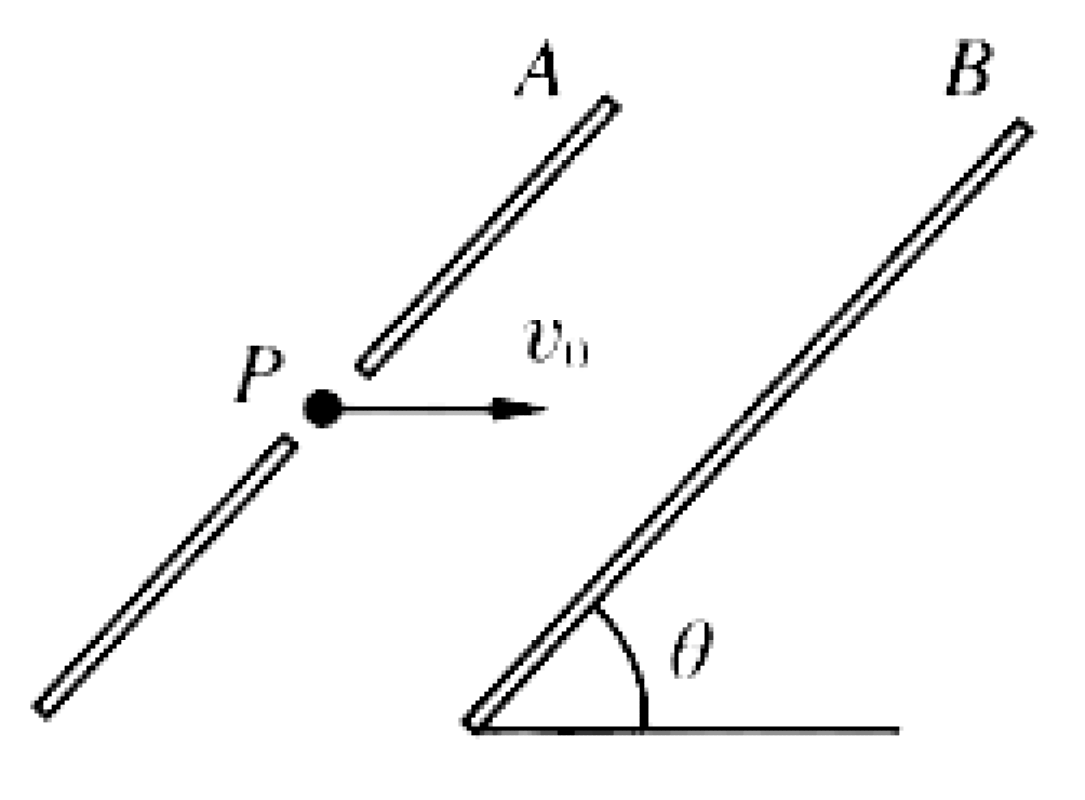
For the ball to return to the exact same point $P$ in time $t$, both components of its displacement (along the plate and perpendicular to it) must vanish at time $t$. Using $\Delta s = v_{\parallel,0} t + \tfrac{1}{2} a_\parallel t^2 = 0$ and similarly for the perpendicular direction, and decomposing $v_0$ into plate-aligned components ($v_0 \cos\theta$ along the plate, $v_0 \sin\theta$ perpendicular to it), the magnitudes of acceleration components must satisfy
$$a_\parallel = \dfrac{2 v_0 \cos\theta}{t}, \qquad a_\perp = \dfrac{2 v_0 \sin\theta}{t},$$both directed opposite to the corresponding velocity components. The total acceleration vector therefore points opposite to $\mathbf{v}_0$ (horizontal, opposite to the initial motion), with magnitude
$$|\mathbf{a}| = \dfrac{2 v_0}{t}.$$The two forces acting are gravity (vertical, $mg$ down) and the electric force $qE$ (perpendicular to the plates). For the net force to point horizontally (opposite to $\mathbf{v}_0$), gravity must be balanced by the vertical component of $qE$, and the net horizontal force equals the horizontal component of $qE$:
$$qE \cos\theta = mg, \qquad qE \sin\theta = m \cdot \dfrac{2 v_0}{t}.$$Dividing the second by the first:
$$\tan\theta = \dfrac{2 v_0}{g t} = \dfrac{2 \times 0.1}{10 \times 0.02} = 1 \;\Longrightarrow\; \theta = 45^\circ.$$Then from $qE \cos\theta = mg$:
$$E = \dfrac{mg}{q \cos\theta} = \dfrac{(10^{-3})(10)}{(1.41 \times 10^{-4})(\cos 45^\circ)} = \dfrac{10^{-2}}{1.41 \times 10^{-4} \cdot \tfrac{\sqrt{2}}{2}} \approx 100\ \mathrm{V/m}.$$