Source: High school physics (Chinese)
Problem
In the rectangular coordinate system, three point charges sit on the $x$-axis. $Q_1 = 1.6 \times 10^{-8}$ C is at the origin $O$. The second charge $Q_2$ (unknown) is at $(x_2, y_2) = (3\ \mathrm{m}, 0)$. The third charge $Q_3 = 1.2 \times 10^{-8}$ C is at $(x_3, y_3) = (6\ \mathrm{m}, 0)$. The total electric field at $(x, y) = (8\ \mathrm{m}, 0)$ has magnitude $20.25$ N/C directed in the $+x$ direction.
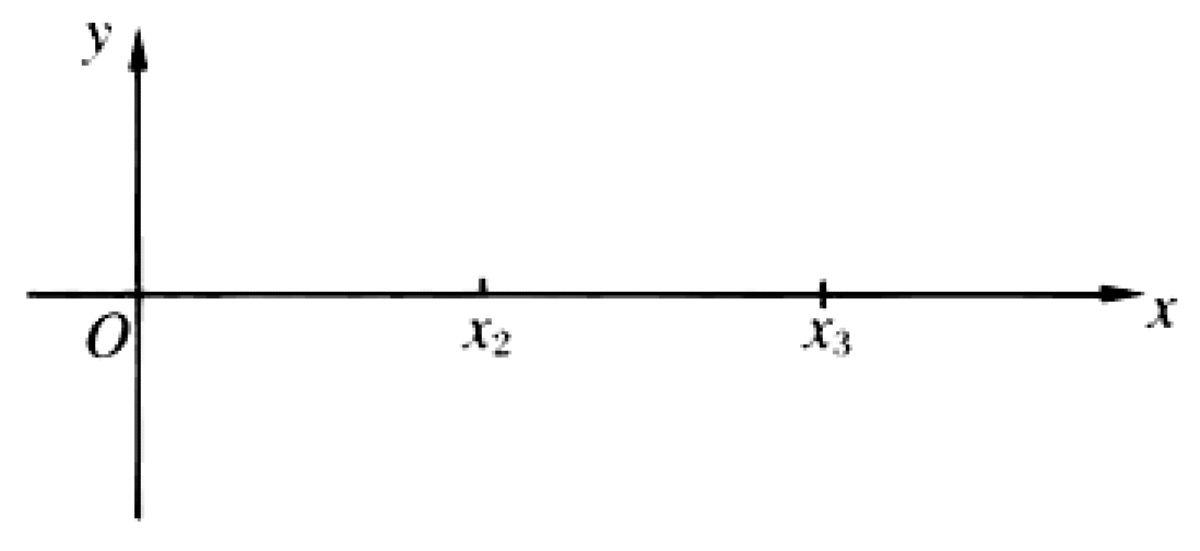
At the field point $x = 8$ m, all three charges lie at smaller $x$, so a positive charge produces a $+x$-direction field and a negative charge produces a $-x$-direction field. With $k = 9.0 \times 10^{9}\ \mathrm{N\cdot m^2/C^2}$:
$$E_1 = \dfrac{kQ_1}{(8-0)^2} = \dfrac{(9.0 \times 10^{9})(1.6 \times 10^{-8})}{64} = 2.25\ \mathrm{N/C}.$$ $$E_3 = \dfrac{kQ_3}{(8-6)^2} = \dfrac{(9.0 \times 10^{9})(1.2 \times 10^{-8})}{4} = 27\ \mathrm{N/C}.$$Adding signed components, $E_1 + E_2 + E_3 = 20.25$:
$$2.25 + \dfrac{kQ_2}{(8-3)^2} + 27 = 20.25 \;\Longrightarrow\; \dfrac{kQ_2}{25} = -9 \;\Longrightarrow\; Q_2 = \dfrac{-9 \times 25}{9.0 \times 10^{9}} = -2.5 \times 10^{-8}\ \mathrm{C}.$$