Source: High school physics (Chinese)
Problem
A mica capacitor is built from $10$ aluminum foil sheets and $9$ mica sheets stacked alternately in parallel layers. The odd-numbered foils are connected together to form one electrode, and the even-numbered foils are connected together to form the other electrode. Each foil and each mica sheet has area $2.5\ \mathrm{cm}^2$; the relative permittivity of mica is $\varepsilon_r = 7.0$; each layer (mica sheet) has thickness $d = 0.15\ \mathrm{mm}$.
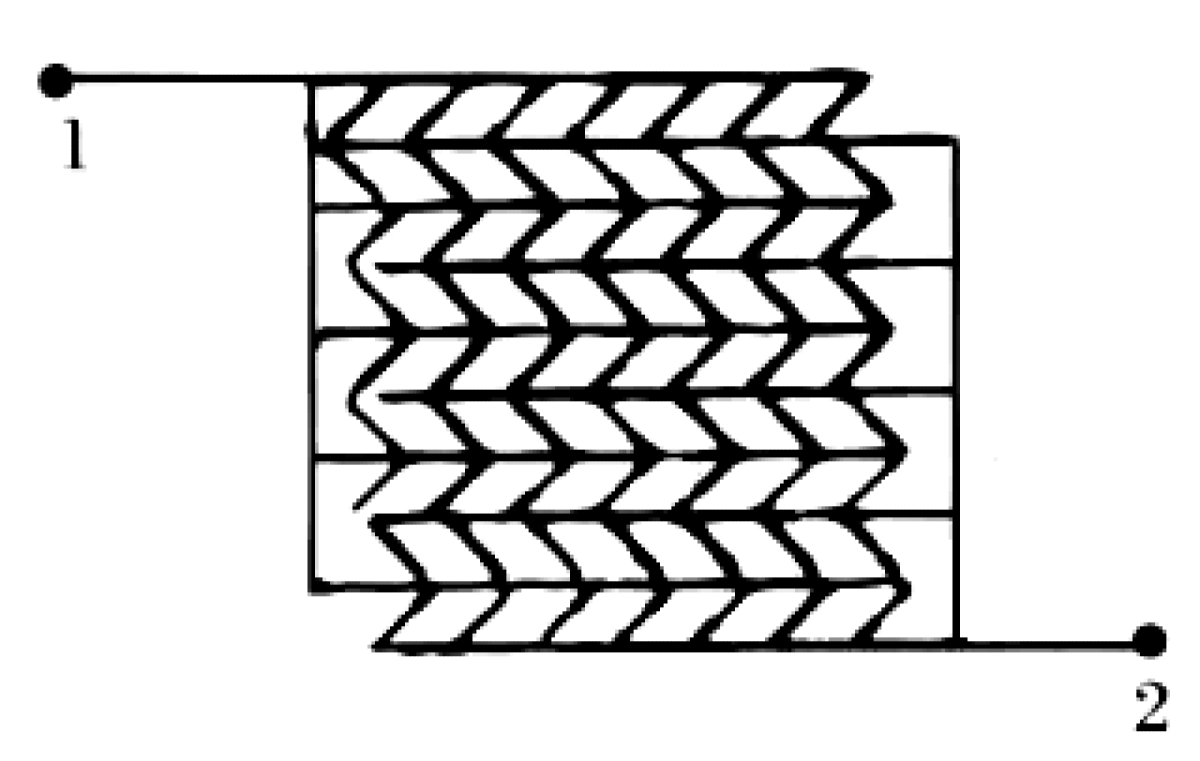
Each mica sheet sits between two adjacent aluminum foils --- one on the odd electrode and one on the even electrode --- and so forms one elementary parallel-plate capacitor between the two electrodes. With $9$ mica layers, there are $9$ such elementary capacitors, all in parallel.
Capacitance of one layer:
$$C_1 = \dfrac{\varepsilon_r \varepsilon_0 A}{d}.$$With $\varepsilon_0 = 8.85 \times 10^{-12}$ F/m, $A = 2.5 \times 10^{-4}\ \mathrm{m}^2$, $d = 1.5 \times 10^{-4}$ m:
$$C_1 = \dfrac{7.0 \times 8.85 \times 10^{-12} \times 2.5 \times 10^{-4}}{1.5 \times 10^{-4}} \approx 1.03 \times 10^{-10}\ \mathrm{F}.$$Total capacitance:
$$C = 9 C_1 \approx 9.3 \times 10^{-10}\ \mathrm{F} = 930\ \mathrm{pF}.$$