Source: High school physics (Chinese)
Problem Sets:
Problem
A conducting rod of length $l$ is initially uncharged. A point charge of magnitude $q$ is placed on the axis of the rod, at a distance $r$ from the rod's left end. After electrostatic equilibrium is reached, induced charges appear on the rod.
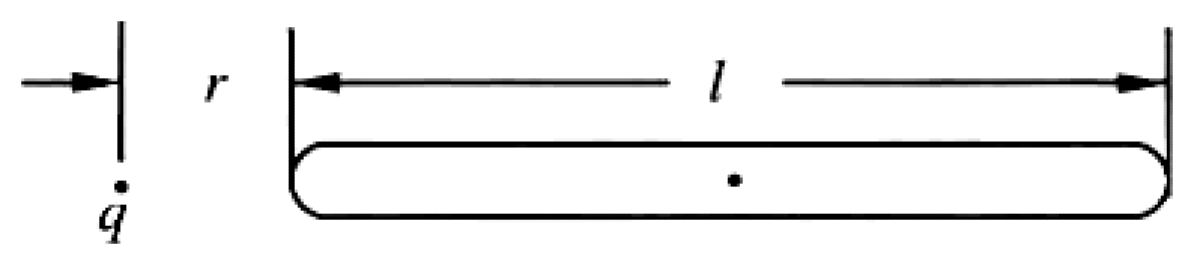
At every interior point of a conductor in electrostatic equilibrium, the total electric field must be zero. The total field is the superposition of (i) the field from the external point charge $q$ and (ii) the field from the induced charges on the rod. Hence at the midpoint of the rod the two contributions cancel:
$$\mathbf{E}_{\text{induced}} = -\mathbf{E}_q.$$The midpoint of the rod is at distance $r + l/2$ from the external charge, so the field from $q$ at that point has magnitude
$$E_q = \dfrac{kq}{(r + l/2)^2} = \dfrac{4kq}{(2r + l)^2}.$$The induced-charge field has the same magnitude (and is directed oppositely along the axis of the rod):
$$E_{\text{induced}} = \dfrac{4kq}{(2r + l)^2}.$$