Source: High school physics (Chinese)
Problem Sets:
Problem
A light string of length $l$ is fixed at its upper end. From its lower end hangs a charged small ball of mass $m$. The system is placed in a uniform horizontal electric field of magnitude $E$. At equilibrium, the string makes an angle $\alpha$ with the vertical, with the ball displaced in the direction of the field.
- What sign of charge does the ball carry? Find the magnitude of the charge.
- If the string is displaced from the equilibrium angle $\alpha$ to a larger angle $\varphi$ (on the same side) and the ball is released from rest, find the value of $\varphi$ for which the ball's speed is exactly zero as the string passes through the vertical position.
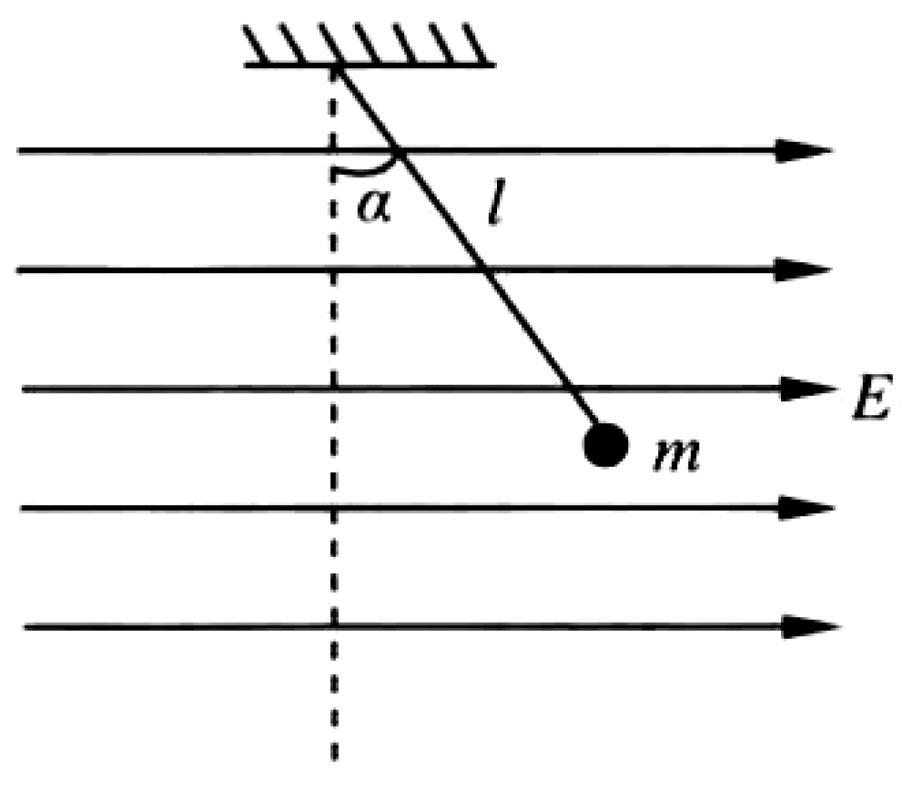
(1) The ball is positively charged; $q = \dfrac{mg \tan \alpha}{E}$. (2) $\varphi = 2\alpha$.
(1) For the ball to be displaced in the direction of $\mathbf{E}$ at equilibrium, the electric force $q\mathbf{E}$ must be in the direction of $\mathbf{E}$, so the ball is positively charged.
Decompose forces at equilibrium:
$$\text{Horizontal: } qE = T \sin \alpha, \qquad \text{Vertical: } mg = T \cos \alpha.$$Dividing the two:
$$\dfrac{qE}{mg} = \tan \alpha \;\Longrightarrow\; q = \dfrac{mg \tan \alpha}{E}.$$(2) From angle $\varphi$ released at rest to angle $0$ (vertical) at rest: total work by all forces is zero (no change in kinetic energy).
Height drop from $\varphi$ to vertical: $\Delta h = l(1 - \cos \varphi)$. Work by gravity: $W_g = mg \, l (1 - \cos \varphi)$.
Horizontal displacement from $\varphi$ to vertical is $l \sin \varphi$ opposite to $\mathbf{E}$ (ball moves back toward the pivot's vertical line). Work by electric force: $W_E = -qE \, l \sin \varphi$.
Set $W_g + W_E = 0$:
$$mg(1 - \cos \varphi) = qE \sin \varphi \;\Longrightarrow\; \dfrac{qE}{mg} = \dfrac{1 - \cos \varphi}{\sin \varphi} = \tan\!\left(\dfrac{\varphi}{2}\right).$$Using $qE/mg = \tan \alpha$ from (1): $\tan \alpha = \tan(\varphi/2)$, so
$$\varphi = 2\alpha.$$