Source: High school physics (Chinese)
Problem Sets:
Problem
In the non-uniform electric field shown in figure, an electron moves from point $a$ to point $b$ along a field line. The electron is subject only to the electric force, and at point $a$ it has velocity $v_1$ directed along the field line. The field lines are more densely packed at $a$ than at $b$, indicating a stronger field at $a$.
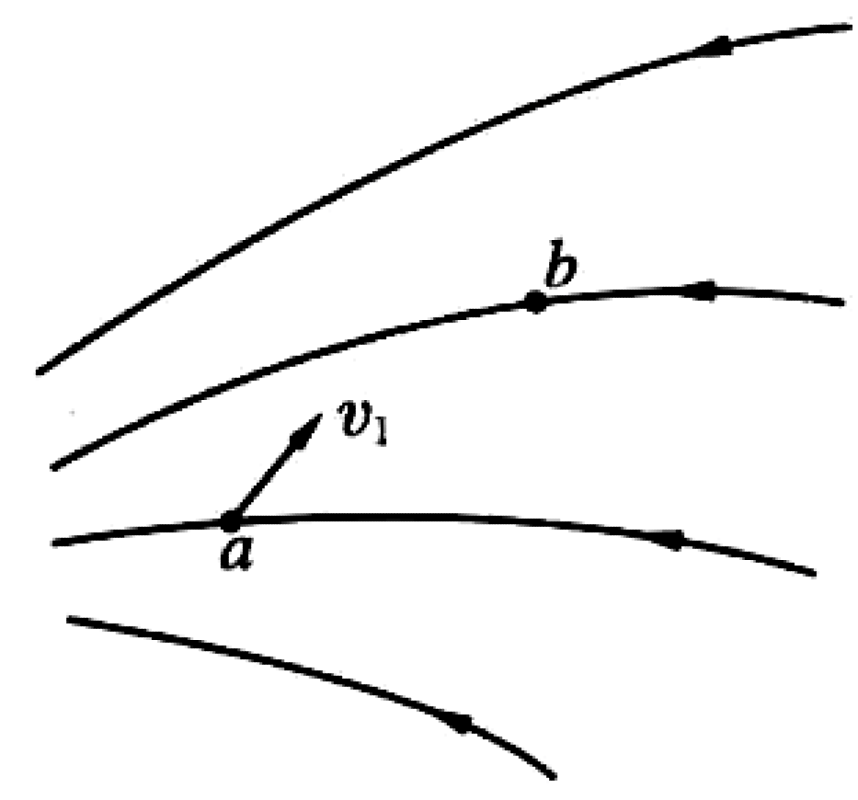
At $b$: speed is larger than at $a$; magnitude of acceleration is smaller than at $a$; electric potential energy is smaller than at $a$.
The electron experiences only the electric force $\mathbf{F} = -e\mathbf{E}$, antiparallel to $\mathbf{E}$. Along the field line the electron's initial velocity $\mathbf{v}_1$ is antiparallel to $\mathbf{E}$, so the force on the electron is the same as its velocity: the electron accelerates as it moves from $a$ to $b$. Hence the speed at $b$ is larger than at $a$.
Acceleration magnitude is $|\mathbf{a}| = eE/m$. Since the field is weaker at $b$ (less dense field lines), the acceleration at $b$ is smaller than at $a$.
The potential increases from $a$ to $b$ in the direction of $\mathbf{E}$, so $V_a < V_b$. The electron's potential energy is $U = -eV$, so $U_b < U_a$: the electron's electric potential energy is smaller at $b$ (consistent with the gain of kinetic energy).