Source: High school physics (Chinese)
Problem Sets:
Problem
A positive charge $Q$ sits at the origin of the coordinate system. Point $P$ has coordinates $(1, 1)$.
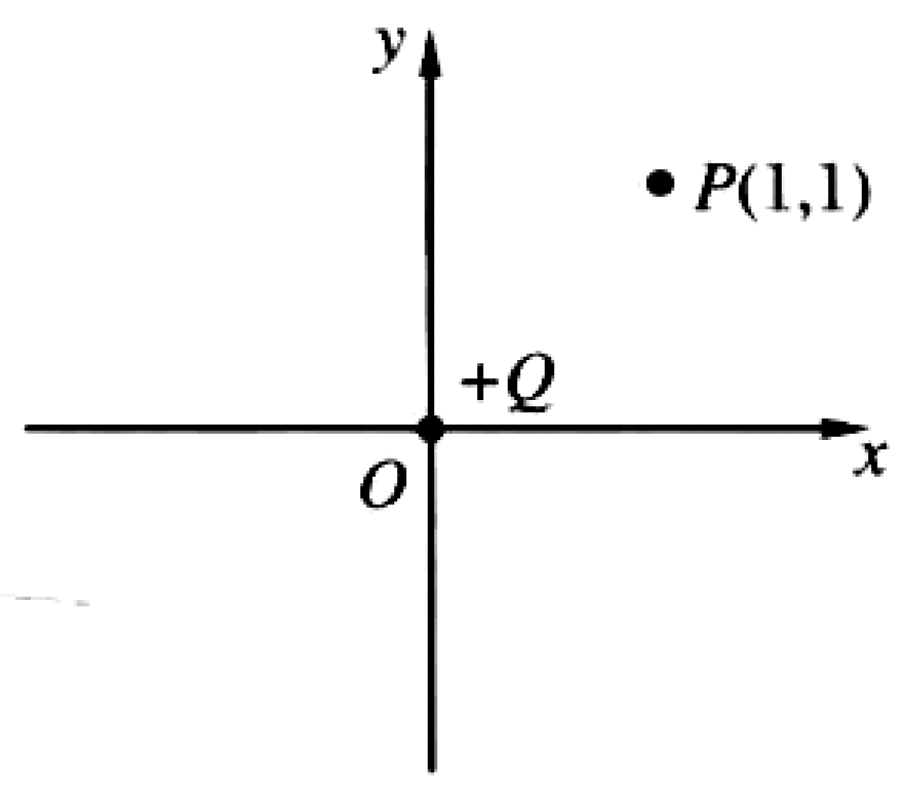
The field $\mathbf{E}_1$ at $P$ from $+Q$ points outward from the origin --- i.e.~along $\hat{r}_{OP}$, in the direction $(1,1)/\sqrt{2}$. Its magnitude is
$$E_1 = \dfrac{kQ}{|OP|^2} = \dfrac{kQ}{(\sqrt{2})^2} = \dfrac{kQ}{2}.$$For the total field at $P$ to vanish, the field $\mathbf{E}_2$ from $-2Q$ must be equal and opposite. Since $-2Q$ is negative, its field at $P$ points from $P$ toward $-2Q$, so $-2Q$ must lie along the line through $O$ and $P$, on the opposite side of $P$ from the $+y=x$ direction --- i.e.~on the ray from $P$ through $O$ and beyond.
Let $r'$ be the distance from $-2Q$ to $P$. Equating magnitudes:
$$\dfrac{k \cdot 2Q}{r'^2} = \dfrac{kQ}{2} \;\Longrightarrow\; r' = 2.$$Starting at $P = (1,1)$ and moving a distance $2$ in the direction $-\hat{r}_{OP} = (-1,-1)/\sqrt{2}$, the location is
$$P + 2 \cdot \tfrac{(-1,-1)}{\sqrt{2}} = (1 - \sqrt{2},\, 1 - \sqrt{2}) \approx (-0.414,\, -0.414).$$