Source: High school physics (Chinese)
Problem
In the circuit of Figure, $C_1 = 20\ \mu\mathrm{F}$ and $C_2 = 5\ \mu\mathrm{F}$. Switch $S$ first connects $C_1$ to a battery of voltage $U = 1000$ V, fully charging $C_1$ (with $C_2$ disconnected). The switch is then thrown to the other side, disconnecting the battery and connecting $C_1$ in parallel with $C_2$.
- Find the charges on $C_1$ and $C_2$ after the switch is flipped.
- Find the voltages across $C_1$ and $C_2$ after the switch is flipped.
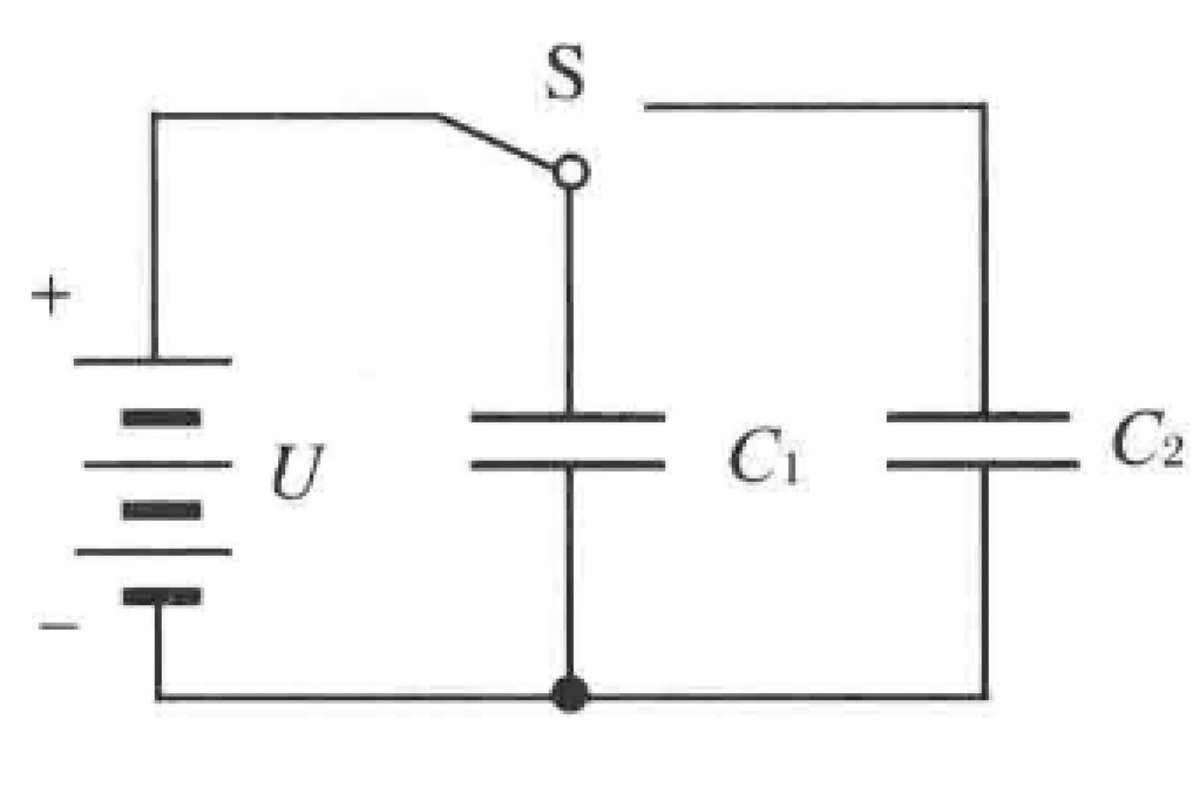
(1) $Q_1 = 1.6 \times 10^{-2}$ C; $Q_2 = 4.0 \times 10^{-3}$ C. (2) $U_1 = U_2 = 800$ V.
Initial charge on $C_1$ from the battery:
$$Q_0 = C_1 U = 20 \times 10^{-6} \times 1000 = 2.0 \times 10^{-2}\ \mathrm{C}.$$After the switch is flipped, $C_1$ and $C_2$ are in parallel. Charge is conserved on the isolated $C_1$--$C_2$ system:
$$Q_1 + Q_2 = Q_0.$$In parallel they share a common voltage $U' = U_1 = U_2$, so $Q_i = C_i U'$:
$$U' = \dfrac{Q_0}{C_1 + C_2} = \dfrac{2.0 \times 10^{-2}}{25 \times 10^{-6}} = 800\ \mathrm{V}.$$Hence:
$$Q_1 = C_1 U' = 20 \times 10^{-6} \times 800 = 1.6 \times 10^{-2}\ \mathrm{C}, \quad Q_2 = C_2 U' = 5 \times 10^{-6} \times 800 = 4.0 \times 10^{-3}\ \mathrm{C}.$$