Source: High school physics (Chinese)
Problem
Four capacitors, each of capacitance $C$, are connected in two different configurations between terminals $A$ and $B$, as shown in Figure. In configuration (a), four capacitors are arranged in a series chain enclosed in a loop, with $A$ tied to one end of the loop and $B$ tied to the midpoint of the chain (so two capacitors lie between $A$ and $B$ on each side of the loop). In configuration (b), the same four-capacitor loop is used, but $B$ is tied between the third and fourth capacitor (so one branch has three capacitors in series and the other branch has one capacitor).
- Find the equivalent capacitance between $A$ and $B$ for configuration (a).
- Find the equivalent capacitance between $A$ and $B$ for configuration (b).
- Which configuration has the larger equivalent capacitance?
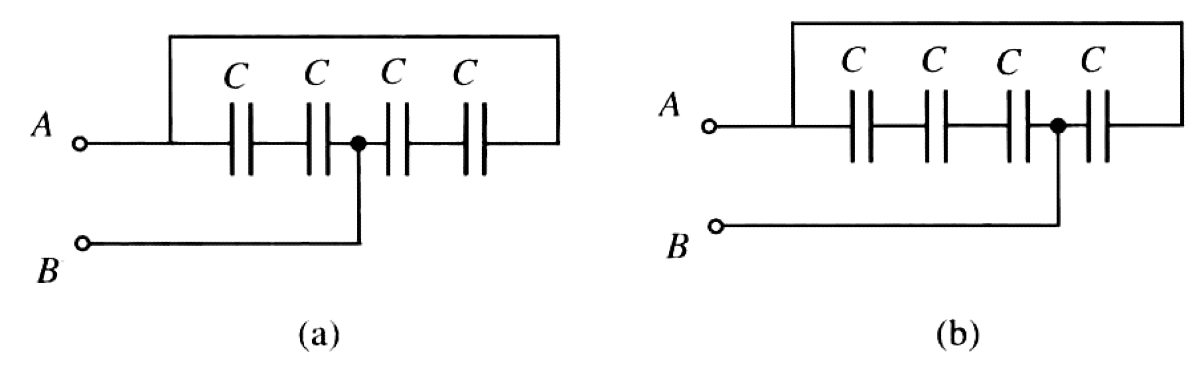
For each configuration, the loop splits into two parallel branches between $A$ and $B$. Series combination: $C_{\text{series}} = C/n$ for $n$ equal capacitors. Parallel combination: capacitances add.
(a) Two branches of two capacitors each: each branch has $C/2$. Parallel total:
$$C_{AB}^{(a)} = \dfrac{C}{2} + \dfrac{C}{2} = C.$$(b) One branch of three capacitors ($C/3$) and one branch of one capacitor ($C$). Parallel total:
$$C_{AB}^{(b)} = \dfrac{C}{3} + C = \dfrac{4C}{3}.$$Since $4C/3 > C$, configuration (b) has the larger equivalent capacitance.