Source: High school physics (Chinese)
Problem
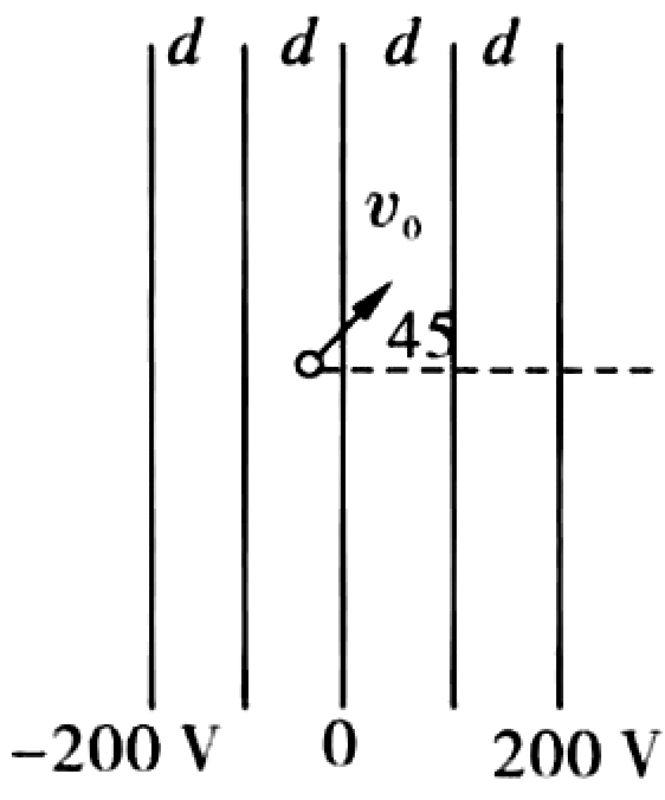
As shown in the figure, a uniform electric field has vertical equipotential surfaces at -200 V, 0 V, and 200 V, each separated by $d = 1$ cm. A small ball of mass $m = 10$ g is launched from the 0 V line with an initial velocity $v_0 = 1$ m/s at an angle of 45° to the horizontal. The ball moves in a straight line. Use $g = 10$ m/s$^2$.
- What is the sign and magnitude of the ball's charge?
- What is the maximum distance the ball travels along its initial direction?
[Q1] Positive, $q = 5 \times 10^{-6}$ C [Q2] $s = \frac{\sqrt{2}}{40}$ m
The ball is subject to gravitational force $F_g = mg$ (downwards) and electric force $F_e = qE$ (horizontal). For the ball to move in a straight line at 45°, the net force must be collinear with the velocity. This requires the magnitudes of the vertical and horizontal forces to be equal.
The electric field points from high potential (200 V) to low potential (-200 V), i.e., to the left.
$$E = \frac{\Delta V}{d} = \frac{200 \text{ V}}{0.01 \text{ m}} = 20000 \text{ V/m}$$[Q1] The net force must be directed downwards and to the left (anti-parallel to $v_0$) for deceleration to occur. Thus, the electric force must be to the left. Since $\vec{F}_e = q\vec{E}$ and $\vec{E}$ is to the left, the charge $q$ must be positive. For the net force to be at 45°, we must have $F_e = F_g$.
$$qE = mg \implies q = \frac{mg}{E}$$ $$q = \frac{(0.01 \text{ kg})(10 \text{ m/s}^2)}{20000 \text{ V/m}} = 5 \times 10^{-6} \text{ C}$$[Q2] The net force is $F_{net} = \sqrt{F_g^2 + F_e^2} = \sqrt{(mg)^2 + (mg)^2} = mg\sqrt{2}$. This force causes a constant deceleration $a = F_{net}/m = g\sqrt{2}$. Using the kinematic equation $v_f^2 = v_i^2 + 2as$, the ball stops when $v_f=0$. The distance $s$ is:
$$0 = v_0^2 - 2as \implies s = \frac{v_0^2}{2a} = \frac{v_0^2}{2g\sqrt{2}}$$ $$s = \frac{(1 \text{ m/s})^2}{2(10 \text{ m/s}^2)\sqrt{2}} = \frac{1}{20\sqrt{2}} \text{ m} = \frac{\sqrt{2}}{40} \text{ m}$$