Source: High school physics (Chinese)
Problem Sets:
Problem
As shown in the figure, there is a uniform electric field between parallel plates A and B, which carry equal and opposite charges in the air. The electric field strength is $E = 2 \times 10^4$ V/m, and the distance between the plates is 10 cm. In the electric field, point C is 3 cm from plate B, and point D is 2 cm from plate A.
- Between points C and D, which has a higher electric potential? What is the potential difference $U_{CD}$?
- If plate B is grounded ($U_B = 0$), what are the potentials $U_C$ and $U_D$? If plate A is grounded, what are $U_C$ and $U_D$? Is $U_{CD}$ the same in both cases?
- An electron moves from point C to point D. How much work is done by the electric field? If the electron is first moved to point E, and then to point D, how much work is done by the electric field?
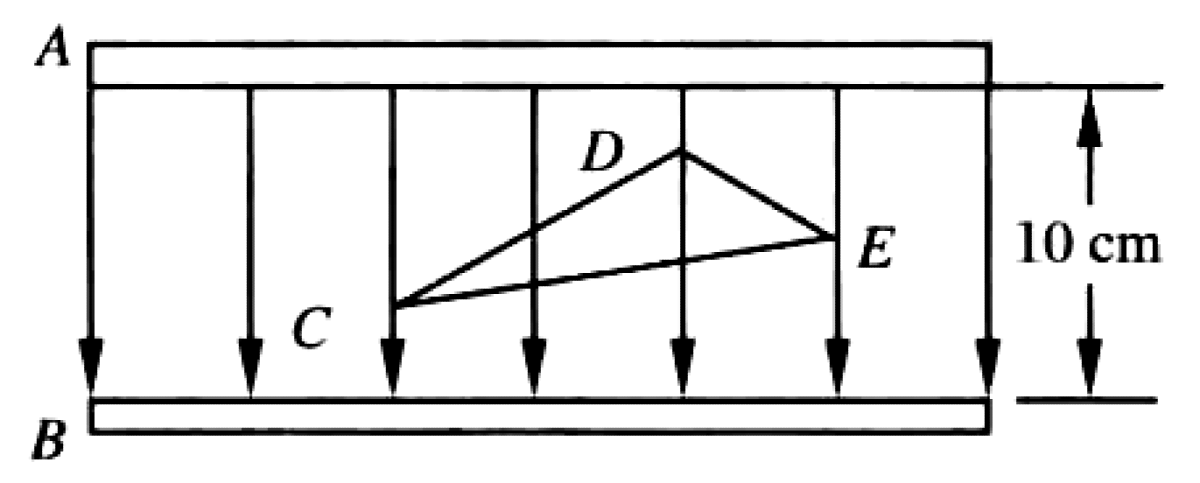
[Q1] Point D has a higher potential. $U_{CD} = -1000$ V. [Q2] If B is grounded: $U_C = 600$ V, $U_D = 1600$ V. If A is grounded: $U_C = -1400$ V, $U_D = -400$ V. Yes, $U_{CD}$ is the same in both cases. [Q3] $W_{C \to D} = 1.6 \times 10^{-16}$ J. $W_{C \to E \to D} = 1.6 \times 10^{-16}$ J.
Let the position of plate B be $y=0$ and plate A be $y=0.1$ m. The electric field $\vec{E}$ points from A to B (downwards). The potential increases in the direction opposite to the electric field. The vertical position of C is $y_C = 0.03$ m. The vertical position of D is $y_D = 0.1 \text{ m} - 0.02 \text{ m} = 0.08$ m.
[Q1] Since $y_D > y_C$, point D has a higher potential than C. The potential difference $U_{CD} = U_C - U_D$ is calculated based on the vertical separation $d_{CD,y} = y_C - y_D$.
$$U_{CD} = E d_{CD,y} = E(y_C - y_D)$$ $$U_{CD} = (2 \times 10^4 \text{ V/m})(0.03 \text{ m} - 0.08 \text{ m}) = -1000 \text{ V}$$[Q2] The choice of ground (zero potential) determines the absolute potential but not the potential difference. Case 1: Plate B is grounded ($U_B = 0$). The potential at height $y$ is $U(y) = E y$.
$$U_C = E y_C = (2 \times 10^4 \text{ V/m})(0.03 \text{ m}) = 600 \text{ V}$$ $$U_D = E y_D = (2 \times 10^4 \text{ V/m})(0.08 \text{ m}) = 1600 \text{ V}$$Case 2: Plate A is grounded ($U_A = 0$). The potential at height $y$ (relative to B) is $U(y) = E(y - d_{AB})$.
$$U_C = E(y_C - d_{AB}) = (2 \times 10^4 \text{ V/m})(0.03 \text{ m} - 0.1 \text{ m}) = -1400 \text{ V}$$ $$U_D = E(y_D - d_{AB}) = (2 \times 10^4 \text{ V/m})(0.08 \text{ m} - 0.1 \text{ m}) = -400 \text{ V}$$In both cases, $U_{CD} = U_C - U_D = -1000 \text{ V}$, so it is the same.
[Q3] The work done by the electric field on a charge $q$ is $W_{C \to D} = q U_{CD}$. For an electron, $q = -e$.
$$W_{C \to D} = (-e)U_{CD} = (-1.6 \times 10^{-19} \text{ C})(-1000 \text{ V}) = 1.6 \times 10^{-16} \text{ J}$$The electric field is conservative, so the work done is independent of the path. Therefore, the work done along the path C-E-D is the same as the work done along the direct path C-D.
$$W_{C \to E \to D} = W_{C \to D}$$