Source: Physics Competition - Mechanics
Problem
A pendulum of length $4a$ is suspended from the origin O. Its swing is constrained by two baffles shaped as inverted cycloids, described parametrically by $x = a(\varphi - \sin\varphi)$ and $y = a(1-\cos\varphi)$. The pendulum string wraps around these baffles as it swings. The y-axis points downwards.
- Prove that the trajectory of the pendulum bob is also a cycloid.
- Prove that the motion is simple harmonic motion, independent of amplitude, and find its period.
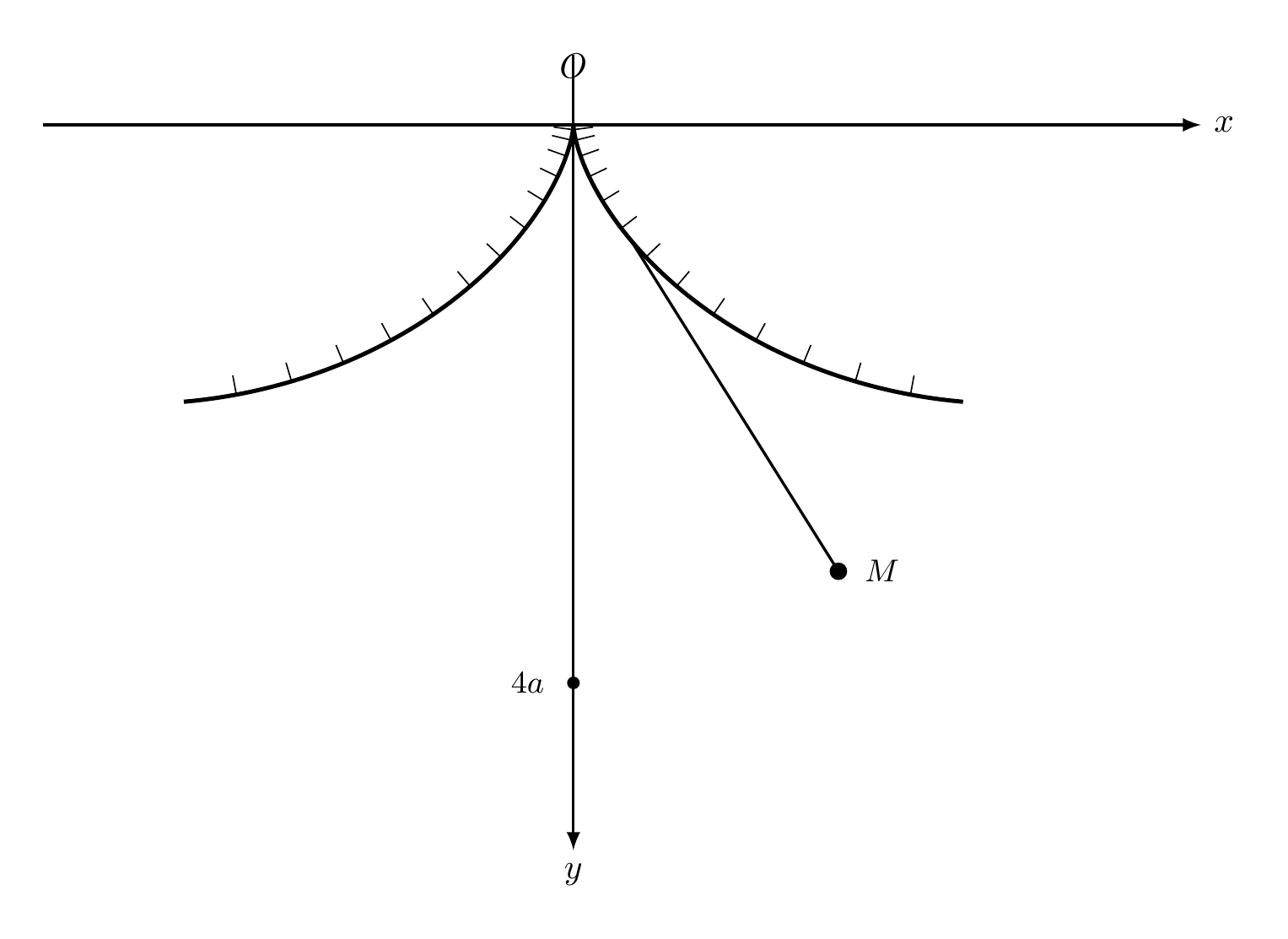
Cycloidal pendulum
[Q1] The trajectory of the bob is a cycloid because its intrinsic equation is $s = 4a\sin\theta$, where $s$ is the arc length from the lowest point and $\theta$ is the angle of the tangent line with the horizontal. [Q2] The motion is simple harmonic motion described by $\ddot{s} + (g/4a)s = 0$. The period is:
$$T = 2\pi\sqrt{\frac{4a}{g}} = 4\pi\sqrt{\frac{a}{g}}$$[Q1] The bob's trajectory is the involute of the cycloid baffles. We will show that the involute of a cycloid is an identical, shifted cycloid by deriving the intrinsic equation of the trajectory. Let P be the point of contact on the baffle, parameterized by $\varphi$. The angle $\theta$ of the free string with the vertical (y-axis) is $\theta = \varphi/2$. The arc length of the baffle from the cusp O to P is $s_P = 4a(1-\cos(\varphi/2))$. The free length of the string, which is also the radius of curvature $\rho$ of the bob's path, is $\rho = 4a - s_P = 4a - 4a(1-\cos(\varphi/2)) = 4a\cos(\varphi/2)$. Substituting $\varphi/2 = \theta$, we get $\rho = 4a\cos\theta$.
The tangent to the bob's path is perpendicular to the string. Since the string makes an angle $\theta$ with the vertical, the tangent makes an angle $\theta$ with the horizontal. Let $s$ be the arc length of the bob's trajectory measured from its lowest point ($\theta=0$).
$$ds = \rho \, d\theta = 4a\cos\theta \, d\theta$$Integrating from the lowest point gives:
$$s(\theta) = \int_0^\theta 4a\cos\theta' \, d\theta' = 4a\sin\theta$$The intrinsic equation $s = 4a\sin\theta$ (where $\theta$ is the angle of the tangent with the horizontal) uniquely defines a cycloid generated by a circle of radius $a$.
[Q2] We analyze the forces on the bob along the tangential direction of its path. The only force with a tangential component is gravity. The tangential component of the gravitational force is $F_t = -mg\sin\theta$. Applying Newton's second law for tangential motion:
$$m\ddot{s} = F_t = -mg\sin\theta$$From the result of Q1, we have a relationship between the arc length $s$ and the angle $\theta$: $\sin\theta = s/(4a)$. Substituting this into the equation of motion:
$$m\ddot{s} = -mg\left(\frac{s}{4a}\right)$$ $$\ddot{s} + \left(\frac{g}{4a}\right)s = 0$$This is the equation for Simple Harmonic Motion with the arc length $s$ as the displacement coordinate. The equation is linear, so the motion is isochronous (period is independent of amplitude). The angular frequency of the SHM is $\omega = \sqrt{g/(4a)}$. The period $T$ is calculated from $\omega$.