Source: Physics Competition - Mechanics
Problem
Two cylinders of different radii, $R$ and $r$, rotate in opposite directions about parallel horizontal axes with the same angular velocity $\omega$. The axes are separated by a distance $L$. At $t=0$, a uniform plank of mass $M$ is placed horizontally on the rollers, with its center of mass (CM) initially above the axis of one of the cylinders. The coefficient of kinetic friction is $\mu$. The top surfaces of the rollers move inwards.
- Find the equation of motion for the horizontal displacement $x$ of the plank's CM from the midpoint between the rollers.
- Find the plank's horizontal displacement as a function of time, $x(t)$.
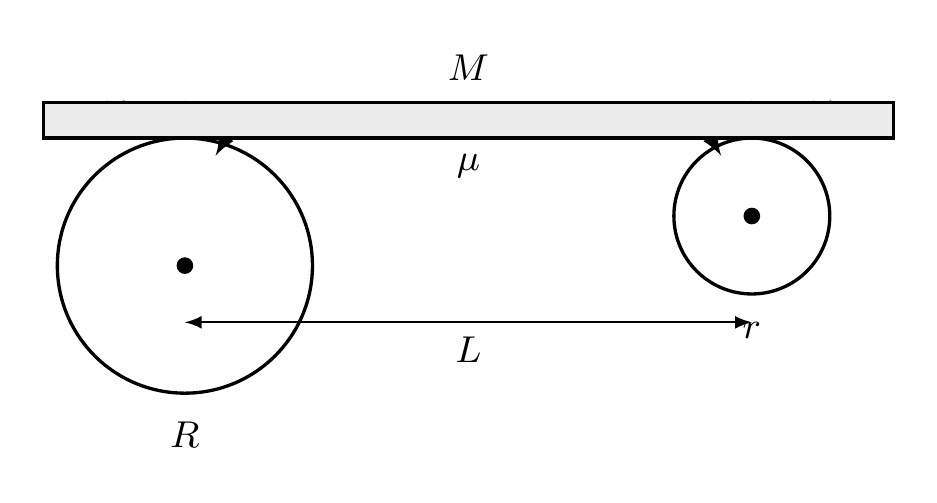
Problem diagram
The equation of motion is:
$$\ddot{x} + \left(\frac{2\mu g}{L}\right)x = 0$$The displacement as a function of time is:
$$x(t) = \frac{L}{2} \cos\left(\sqrt{\frac{2\mu g}{L}} t\right)$$Let the origin be the midpoint between the rollers, so their axes are at $x = -L/2$ and $x = +L/2$. Let $x$ be the position of the plank's CM.
First, we find the normal forces $N_L$ and $N_R$ from the left and right rollers. From vertical equilibrium and torque equilibrium about the CM:
$$N_L + N_R = Mg$$ $$N_L(x + L/2) = N_R(L/2 - x)$$Solving this system gives:
$$N_L = \frac{Mg}{L}(L/2 - x)$$ $$N_R = \frac{Mg}{L}(L/2 + x)$$The friction forces depend on the normal forces: $F_{fL} = \mu N_L$ and $F_{fR} = \mu N_R$. The left roller's top surface moves right, so $F_{fL}$ acts to the right (+x direction). The right roller's top surface moves left, so $F_{fR}$ acts to the left (-x direction). This holds as long as the plank's speed $|\dot{x}|$ is less than the surface speed of the rollers.
Applying Newton's second law for the horizontal motion of the plank:
$$M\ddot{x} = F_{fL} - F_{fR}$$ $$M\ddot{x} = \mu N_L - \mu N_R = \mu \frac{Mg}{L}(L/2 - x) - \mu \frac{Mg}{L}(L/2 + x)$$ $$M\ddot{x} = \frac{\mu Mg}{L}(-2x)$$ $$\ddot{x} = -\left(\frac{2\mu g}{L}\right)x$$This is the equation for Simple Harmonic Motion (SHM) with angular frequency $\omega_{SHM}^2 = \frac{2\mu g}{L}$.
The general solution is $x(t) = A \cos(\omega_{SHM} t + \phi)$. The initial conditions are that the CM is above one cylinder, say the right one, so $x(0) = L/2$, and it is placed from rest, $\dot{x}(0)=0$.
$x(0) = A\cos\phi = L/2$. $\dot{x}(0) = -A\omega_{SHM}\sin\phi = 0 \implies \phi=0$.This gives $A=L/2$.