Source: Physics Competition - Mechanics
Problem
An object of mass $m$ is attached to a light spring with spring constant $k$, which is fixed to the ceiling. Initially, the object rests on a plate P, the spring is unstretched, and its axis is vertical.
- Find the maximum extension $L$ of the spring when the plate starts to move downwards with a constant acceleration $a$.
- Plot the function $L$ versus $a$.
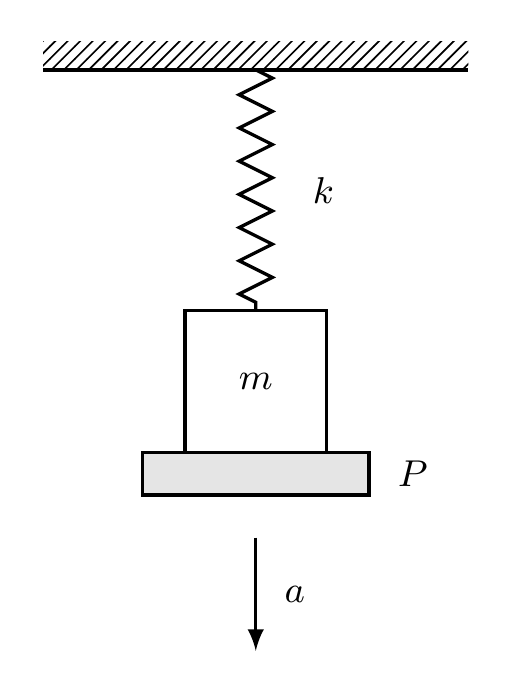
Problem diagram
For $a \ge g$:
$$L = \frac{2mg}{k}$$For $0 \le a < g$:
$$L = \frac{m}{k}\left(g + \sqrt{2ag - a^2}\right)$$The plot of $L$ vs $a$ starts at $(0, mg/k)$ with a vertical tangent, increases and curves to the right, reaching $(g, 2mg/k)$ with a horizontal tangent. For $a>g$, it remains constant at $L=2mg/k$.
The motion depends on whether the object separates from the plate. The condition for separation is that the normal force $N$ from the plate becomes zero. In the lab frame, with downward as positive, the equation of motion for the mass $m$ while on the plate (at displacement $y$) is $mg - ky - N = ma$. Separation occurs when $N=0$.
Case 1: $a \ge g$. If $a \ge g$, then $m(g-a) \le 0$. The normal force $N = m(g-a) - ky$ would be negative even at $y=0$. Thus, the mass separates from the plate immediately at $y=0$ with zero initial velocity. The problem reduces to dropping a mass on a spring from the unstretched position. Using conservation of energy from the initial position ($y=0, v=0$) to the position of maximum extension ($y=L, v=0$), with potential energy zero at $y=0$:
$$0 = \frac{1}{2}kL^2 - mgL$$Solving for $L e 0$ gives the maximum extension.
Case 2: $a < g$. The mass initially moves with the plate. Separation occurs when $N=0$, at a displacement $y_0$ where $mg-ky_0 = ma$.
$$y_0 = \frac{m(g-a)}{k}$$The velocity of the mass at this point is found from kinematics with constant acceleration $a$:
$$v_0^2 = 2ay_0 = \frac{2am(g-a)}{k}$$After separation, the mass moves under gravity and the spring force. We use energy conservation from the point of separation ($y_0, v_0$) to the point of maximum extension ($L, v=0$).
$$\frac{1}{2}mv_0^2 + \frac{1}{2}ky_0^2 - mgy_0 = \frac{1}{2}kL^2 - mgL$$Substituting $y_0$ and $v_0^2$ and simplifying leads to a quadratic equation for $L$:
$$k^2L^2 - 2kmgL + m^2(g-a)^2 = 0$$Solving for $L$ (taking the larger root for maximum extension) gives the result.
Combining the cases, we can plot $L(a)$. The function is continuous and has a continuous first derivative at $a=g$. For $a \to 0^+$, $L \to mg/k$. For $a \to g^-$, $L \to 2mg/k$. The slope at $a \to 0^+$ is infinite, and the slope at $a \to g^-$ is zero.