Source: Physics Competition - Mechanics
Problem
An object of mass $m$ on a horizontal surface with friction coefficient $\mu$ is subject to a restoring force $F=-kx$. There is a perfectly elastic wall at the origin $x=0$. The object is released from rest at $x=x_1 > 0$. Let $x_s = \mu mg/k$ be the magnitude of the displacement where the spring force equals the friction force.
- Find the total time until the object stops permanently.
- Find the final resting position of the object.
- Find the total work done by the object against friction.
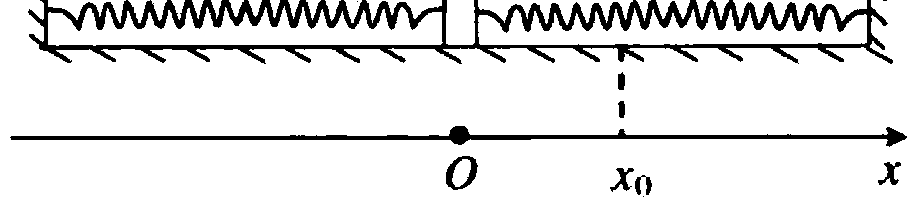
Problem diagram
[Q1] $t_{total} = \frac{1}{\omega} \sum_i \Delta\phi_i$, where $\Delta\phi_i$ are phase changes for each segment, typically involving arccos functions. [Q2] $x_{final}$ must be found by tracing the trajectory until the object comes to rest in the range $|x| \le x_s$. [Q3] $W_{against} = \frac{1}{2}k(x_1^2 - x_{final}^2)$
The object undergoes damped oscillations. The motion consists of segments of SHM about shifted equilibrium points: $x_s$ when moving left, and $-x_s$ when moving right. [Q2] First, find the sequence of right-side turning points. An object starting at a right turning point $x_R$, moving left to the wall, and returning to a new right turning point $x'_R$ loses energy $\Delta E = \mu mg(x_R + x'_R)$. From the work-energy theorem: $\frac{1}{2}kx_R^2 - \frac{1}{2}k(x'_R)^2 = \mu mg(x_R + x'_R)$. This simplifies to $\frac{1}{2}k(x_R - x'_R) = \mu mg$, so the new turning point is $x'_R = x_R - 2\mu mg/k = x_R - 2x_s$. The sequence of right turning points is an arithmetic progression: $x_{R,n} = x_1 - 2nx_s$. This continues until a turning point is not reached. Let $x_{R,last} = x_1 - 2n_{max}x_s$ be the last positive right turning point. The object then moves left. The next left turning point, without a wall, would be at $x_L = 2x_s - x_{R,last}$. If $x_L > 0$ and $|-kx_L| \le \mu mg$ (i.e., $x_L \le x_s$), the object stops at $x_{final} = x_L$. If $x_L<0$, it hits the wall and the process continues. The final position $x_{final}$ is found by tracing these steps until the object stops in the region $|x| \le x_s$. [Q3] The total work done against friction equals the total loss in the system's mechanical energy. Since the object starts and ends at rest, this is the total change in potential energy.
$$W_{against} = -W_{friction} = - \Delta E_{mech} = E_{initial} - E_{final} = \frac{1}{2}kx_1^2 - \frac{1}{2}kx_{final}^2$$[Q1] The total time is the sum of the durations for each segment of motion. Let $\omega = \sqrt{k/m}$. Each segment is a fraction of a SHM period. The time to travel between two points $x_a$ and $x_b$ in a half-cycle governed by a center $x_c$ and amplitude $A$ can be found from $x(t) = x_c + A\cos(\omega t)$. This requires calculating the time for each pass (e.g., $x_{R,n} \to 0$, $0 \to x_{R,n+1}$, etc.) and summing them. The result is a sum of arccosine terms that must be evaluated numerically based on the specific parameters.