Source: Physics Competition - Mechanics
Problem
A block P of mass $m$ is attached to a spring (constant $k$) on a smooth horizontal surface. Another block Q of mass $\beta m$ is in contact with P. A wall is at a distance $L$ from Q's initial position at equilibrium. The blocks are compressed by $L_0$ and released. After separation at the equilibrium point ($x=0$), P completes one full oscillation and then collides with Q, which has traveled to the wall and back. All collisions are perfectly elastic.
- Find the initial compression $L_0$.
- Find the maximum distance of P from the separation point between the first separation and the first collision.
- Find the maximum distance of P from the separation point between the first and second collisions.
- Find the time of the second collision, taking the first collision as $t=0$.
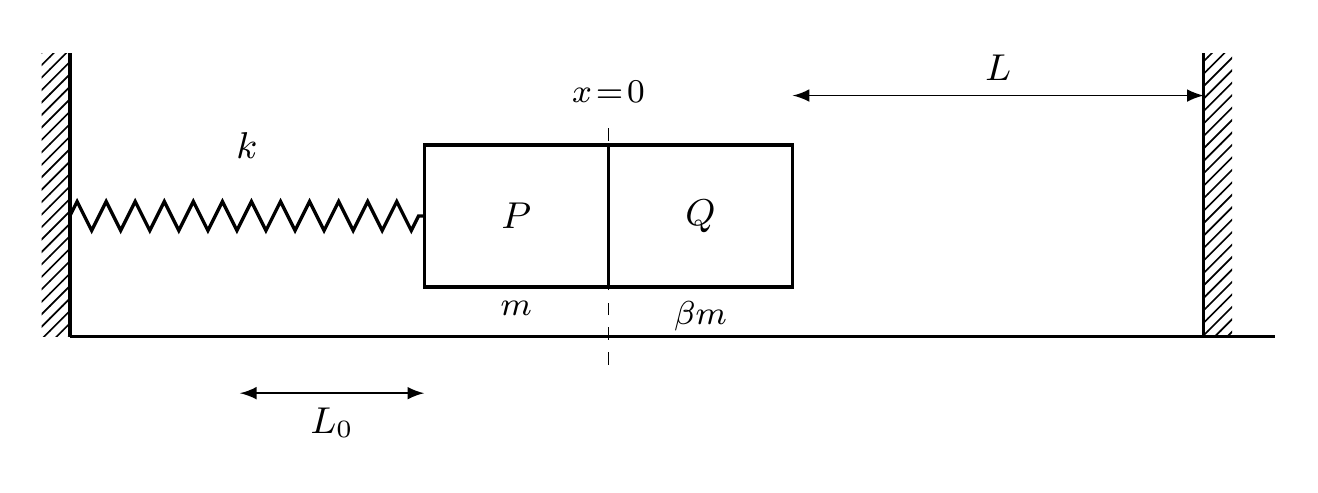
Problem diagram
[Q1] $L_0 = \frac{L\sqrt{1+\beta}}{\pi}$ [Q2] $d_{max,1} = \frac{L}{\pi}$ [Q3] $d_{max,2} = \left|\frac{1-3\beta}{1+\beta}\right| \frac{L}{\pi}$ [Q4] $t_2 = \frac{1+\beta}{3-\beta} T_P$
Initially, blocks P and Q move together as a single mass $M=(1+\beta)m$. They undergo SHM with amplitude $L_0$. They separate at $x=0$ with maximum velocity $v_1 = L_0 \sqrt{k/M} = L_0 \sqrt{k/((1+\beta)m)}$. After separation, P oscillates with mass $m$ and period $T_P = 2\pi\sqrt{m/k}$. Block Q moves at constant velocity $v_1$, travels a distance $2L$ (to the wall and back), taking time $t_Q = 2L/v_1$. The first collision occurs when P completes one full oscillation, so $t_Q = T_P$.
$$ \frac{2L}{L_0 \sqrt{k/((1+\beta)m)}} = 2\pi\sqrt{\frac{m}{k}} \implies \frac{L \sqrt{1+\beta}}{L_0} = \pi$$[Q1] Solving for $L_0$ gives $L_0 = \frac{L\sqrt{1+\beta}}{\pi}$. [Q2] The amplitude of P's oscillation after separation is $A_P = \frac{v_1}{\omega_P} = \frac{L_0 \sqrt{k/((1+\beta)m)}}{\sqrt{k/m}} = \frac{L_0}{\sqrt{1+\beta}}$. Substituting $L_0$ gives $A_P = \frac{L}{\pi}$. This is the maximum distance from the separation point. [Q3] The first collision occurs at $x=0$. Pre-collision velocities are $v_P = v_1$ and $v_Q = -v_1$. For an elastic collision, the post-collision velocity of P is $v'_P = \frac{m - \beta m}{m + \beta m}v_P + \frac{2\beta m}{m + \beta m}v_Q = \frac{1-3\beta}{1+\beta}v_1$. P's new amplitude is $A'_P = \frac{|v'_P|}{\omega_P} = \left|\frac{1-3\beta}{1+\beta}\right|A_P = \left|\frac{1-3\beta}{1+\beta}\right|\frac{L}{\pi}$. This is the new maximum distance. [Q4] Q's post-collision velocity is $v'_Q = \frac{2m}{m+\beta m}v_P + \frac{\beta m - m}{\beta m + m}v_Q = \frac{3-\beta}{1+\beta}v_1$. The time for Q's next round trip to the wall is $t_{Q,2} = \frac{2L}{v'_Q} = \frac{2L}{( (3-\beta)/(1+\beta) ) v_1} = \frac{1+\beta}{3-\beta} \frac{2L}{v_1} = \frac{1+\beta}{3-\beta}T_P$. Since this is an integer multiple of $T_P$ if $\beta$ is rational in a certain way, P will also be at $x=0$ at this time. Thus, the second collision occurs at time $t_2 = t_{Q,2}$.