Source: Physics Competition - Mechanics
Problem
A small ball of mass $m$ is connected between two light vertical elastic ropes. The other ends of the ropes are fixed at points O (above) and O' (below) on the same vertical line. The spring constants are $k_1$ for the upper rope and $k_2$ for the lower rope. When the ball is at rest at its equilibrium position C, the upper and lower ropes are stretched by lengths $l_1$ and $l_2$ respectively. The ball is then pulled vertically downward by a distance $A$ from C and released from rest.
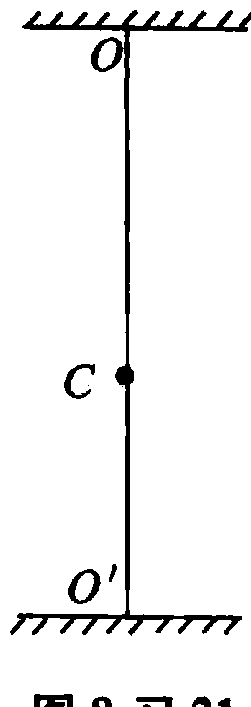
Problem diagram
First, determine the mass $m$ of the ball from the static equilibrium condition at position C. The upward force from the top spring must balance the gravitational force and the downward force from the bottom spring.
$$k_1 l_1 = mg + k_2 l_2$$ $$m = \frac{k_1 l_1 - k_2 l_2}{g}$$Next, determine the effective spring constant $k_{eff}$ for oscillations around the equilibrium point. If the ball is displaced by a distance $y$ downwards from C, the net restoring force $F_{restore}$ is:
$$F_{restore} = (mg + k_2(l_2+y)) - k_1(l_1+y)$$ $$F_{restore} = (mg + k_2 l_2 - k_1 l_1) - (k_1+k_2)y$$Since the term in the first parenthesis is zero from the equilibrium condition, the restoring force is $F_{restore} = -(k_1 + k_2)y$. This is a simple harmonic motion with an effective spring constant $k_{eff} = k_1 + k_2$.
The period of oscillation $T$ is given by:
$$T = 2\pi\sqrt{\frac{m}{k_{eff}}}$$Substituting the expressions for $m$ and $k_{eff}$:
$$T = 2\pi\sqrt{\frac{(k_1 l_1 - k_2 l_2)/g}{k_1 + k_2}}$$The time to return to the release point for the first time is one full period $T$.