Source: Physics Competition - Mechanics
Problem
A mass $m$ on a horizontal surface is attached to two fixed walls by two identical springs, each with spring constant $k$. The coefficient of friction (static and kinetic) is $\mu$. The mass is released from rest at a displacement $x_0$. An "oscillation process" is defined as a half-cycle (e.g., moving from the rightmost to the leftmost point).
- How many oscillation processes does the object undergo before stopping?
- What is the total time elapsed from release until the object stops?
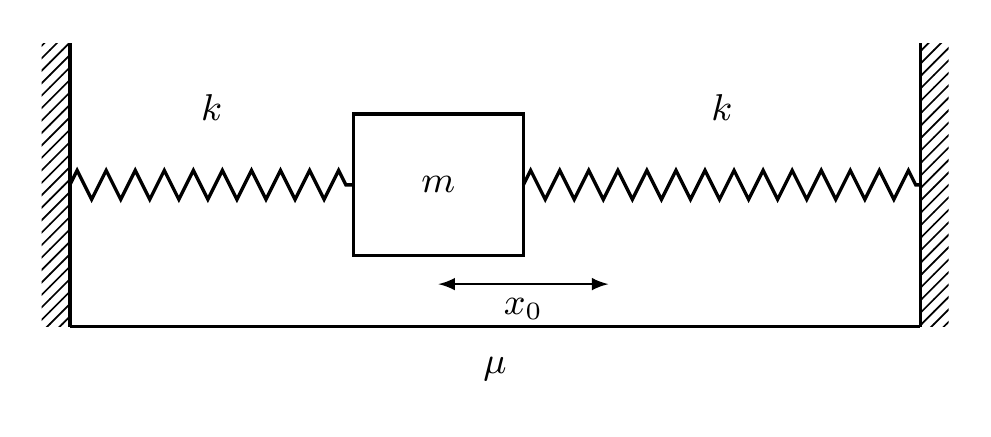
Problem diagram
[Q1] $N = \left\lfloor \frac{kx_0}{\mu mg} + \frac{1}{2} \right\rfloor$ [Q2] $t = \left\lfloor \frac{kx_0}{\mu mg} + \frac{1}{2} \right\rfloor \pi\sqrt{\frac{m}{2k}}$
The total spring constant is $K_{eff} = 2k$. The constant friction force has magnitude $f = \mu mg$.
The motion within each half-cycle is SHM about a shifted equilibrium. We can use the work-energy theorem to find the change in amplitude. Over one half-cycle, from a turning point at $x=A_{i}$ to the next at $x=-A_{i+1}$, the work done by friction is $W_f = -f(A_i + A_{i+1})$. The change in spring potential energy is $\Delta E_p = \frac{1}{2}(2k)A_{i+1}^2 - \frac{1}{2}(2k)A_i^2 = k(A_{i+1}-A_i)(A_{i+1}+A_i)$. Equating $W_f = \Delta E_p$ gives $-\mu mg = k(A_{i+1}-A_i)$, so the amplitude decreases by a constant amount $\Delta A = A_i - A_{i+1} = \frac{\mu mg}{k}$ in each half-cycle.
The object stops at a turning point, say after $N$ processes, when the amplitude $A_N$ is small enough that the maximum spring force cannot overcome static friction. The stopping condition is $|F_{sp}| \le f_{s,max}$, which means $2k A_N \le \mu mg$, or $A_N \le \frac{\mu mg}{2k}$. The amplitude after $N$ processes is $A_N = x_0 - N \cdot \Delta A = x_0 - N \frac{\mu mg}{k}$. The object completes $N$ processes and comes to rest if the spring force at $A_N$ is insufficient to start the next half-cycle. This means the condition $2k A_N \le \mu mg$ is met for the first time.
$$2k \left(x_0 - N \frac{\mu mg}{k}\right) \le \mu mg$$ $$2kx_0 - 2N\mu mg \le \mu mg \implies 2N+1 \ge \frac{2kx_0}{\mu mg} \implies N \ge \frac{kx_0}{\mu mg} - \frac{1}{2}$$Since $N$ must be an integer, the number of completed processes is the smallest integer satisfying this, which can be written as $N = \lfloor \frac{kx_0}{\mu mg} + \frac{1}{2} \rfloor$.
[Q2] The presence of a constant friction force shifts the equilibrium position but does not change the angular frequency of oscillation, $\omega = \sqrt{2k/m}$. The time for each process (half-cycle) is constant:
$$t_{1/2} = \frac{T}{2} = \frac{1}{2}\frac{2\pi}{\omega} = \pi\sqrt{\frac{m}{2k}}$$The total time is the number of completed processes, $N$, multiplied by the time for one process.
$$t_{total} = N \cdot t_{1/2} = \left\lfloor \frac{kx_0}{\mu mg} + \frac{1}{2} \right\rfloor \pi\sqrt{\frac{m}{2k}}$$