Source: Physics Competition - Mechanics
Problem Sets:
Problem
A planar mechanism is shown in the figure. The lengths of the rods are $\overline{OA} = \overline{BC} = \sqrt{3}r$ and $\overline{AB} = 2\overline{CD} = 2r$. Rod OA rotates about a fixed pivot O with angular velocity $\omega$ (clockwise), and rod CD rotates about a fixed pivot D with angular velocity $2\omega$ (clockwise). At the instant shown, rod OA is vertical and perpendicular to rod AB, which is horizontal. Rod CD is also horizontal. The angle between rod BC and the horizontal is $60^\circ$.
- Determine the location of the instantaneous center of velocity for each moving rod.
- Determine the angular velocity of each moving rod.
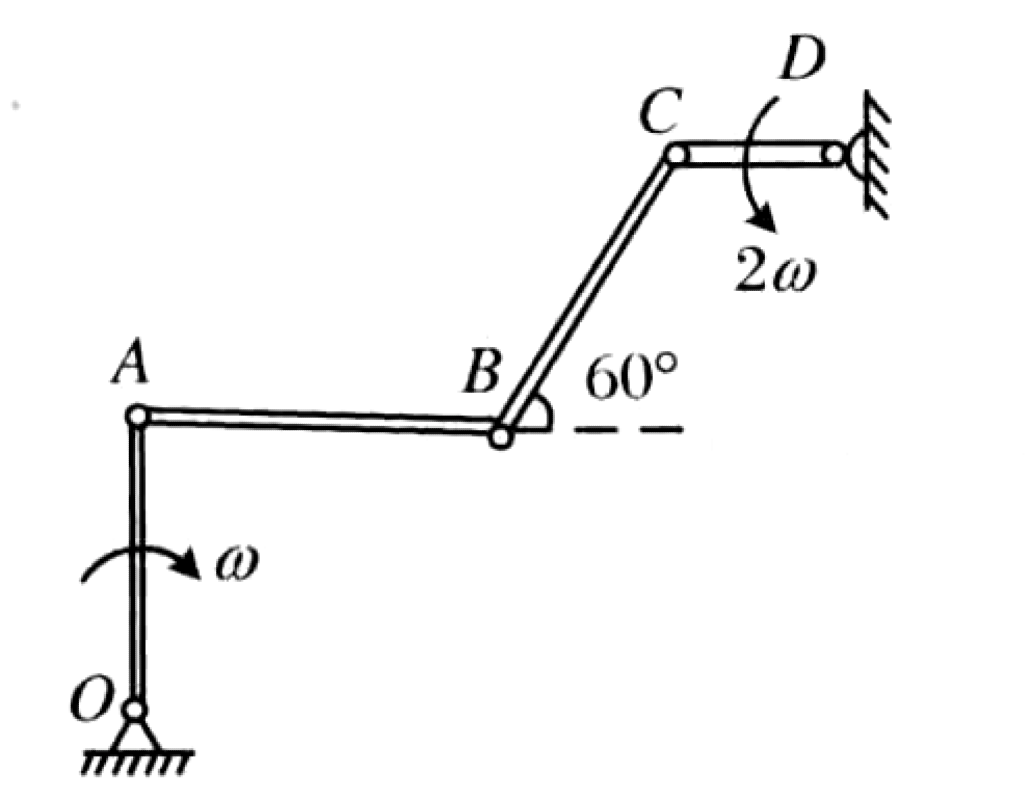
P0743-problem-1
Rod OA: ICV at O; $\omega_{OA} = \omega$ (clockwise). Rod AB: ICV ($P_{AB}$) is on rod OA, at a distance $r/\sqrt{3}$ from O; $\omega_{AB} = 1.5\omega$ (clockwise). Rod BC: ICV ($P_{BC}$) is on the line extending from rod CD, at a distance $\sqrt{3}r$ from C; $\omega_{BC} = \frac{2\sqrt{3}}{3}\omega$ (counter-clockwise). Rod CD: ICV at D; $\omega_{CD} = 2\omega$ (clockwise).
Let's establish a coordinate system with pivot O at the origin $(0,0)$. Let $\hat{i}$ be horizontal to the right and $\hat{j}$ be vertical upwards. The angular velocities are clockwise, so they are in the $-\hat{k}$ direction. The positions of the joints are: A at $(0, \sqrt{3}r)$ and B at $(2r, \sqrt{3}r)$. The velocity of point A is:
$$\vec{v}_A = \vec{\omega}_{OA} \times \vec{r}_{A/O} = (-\omega \hat{k}) \times (\sqrt{3}r \hat{j}) = \omega\sqrt{3}r \hat{i}$$The position of C relative to B is $\vec{r}_{C/B} = \overline{BC}(\cos 60^\circ \hat{i} + \sin 60^\circ \hat{j}) = \sqrt{3}r(\frac{1}{2}\hat{i} + \frac{\sqrt{3}}{2}\hat{j})$. The velocity of C is determined by the rotation of rod CD. The position of C relative to D is $\vec{r}_{C/D} = -r\hat{i}$.
$$\vec{v}_C = \vec{\omega}_{CD} \times \vec{r}_{C/D} = (-2\omega \hat{k}) \times (-r\hat{i}) = -2\omega r \hat{j}$$The velocities of the rods are related by $\vec{v}_C = \vec{v}_B = \vec{v}_A + \vec{\omega}_{AB} \times \vec{r}_{B/A} + \vec{\omega}_{BC} \times \vec{r}_{C/B}$. Let $\vec{\omega}_{AB} = \omega_{AB}\hat{k}$ and $\vec{\omega}_{BC} = \omega_{BC}\hat{k}$.
$$-2\omega r \hat{j} = \omega\sqrt{3}r \hat{i} + (\omega_{AB}\hat{k} \times 2r\hat{i}) + (\omega_{BC}\hat{k} \times (\frac{\sqrt{3}}{2}r\hat{i} + \frac{3}{2}r\hat{j}))$$ $$-2\omega r \hat{j} = \omega\sqrt{3}r \hat{i} + 2r\omega_{AB}\hat{j} + \frac{\sqrt{3}}{2}r\omega_{BC}\hat{j} - \frac{3}{2}r\omega_{BC}\hat{i}$$Equating components:
$\hat{i}: 0 = \omega\sqrt{3}r - \frac{3}{2}r\omega_{BC} \implies \omega_{BC} = \frac{2\sqrt{3}}{3}\omega$ (Counter-clockwise) $\hat{j}: -2\omega r = 2r\omega_{AB} + \frac{\sqrt{3}}{2}r\omega_{BC} \implies -2\omega = 2\omega_{AB} + \frac{\sqrt{3}}{2}(\frac{2\sqrt{3}}{3}\omega) = 2\omega_{AB} + \omega \implies \omega_{AB} = -\frac{3}{2}\omega$ (Clockwise)The instantaneous center of velocity (ICV) for any rod is the intersection of the lines perpendicular to the velocity vectors at two distinct points on the rod.
- Rods OA and CD rotate about fixed pivots, so their ICVs are O and D, respectively.
- ICV of AB ($P_{AB}$): $\vec{v}_A$ is horizontal, so the perpendicular is the vertical line through A (the line containing OA). The velocity of B is $\vec{v}_B = \vec{v}_A + \vec{\omega}_{AB} \times \vec{r}_{B/A} = \omega\sqrt{3}r \hat{i} - 3\omega r \hat{j}$. The line perpendicular to $\vec{v}_B$ at B has a slope of $\frac{\sqrt{3}}{3}$ (i.e., $30^\circ$ to the horizontal). $P_{AB}$ is the intersection of this line with the line OA. This places $P_{AB}$ on rod OA, at a distance of $r/\sqrt{3}$ from O.
- ICV of BC ($P_{BC}$): $\vec{v}_C$ is vertical, so the perpendicular is the horizontal line through C (the line containing CD). The perpendicular to $\vec{v}_B$ at B is the same line as above. $P_{BC}$ is the intersection of this line with the line CD. This places $P_{BC}$ on the extension of rod CD, at a distance of $\sqrt{3}r$ from C.