Source: Physics Competition - Mechanics
Problem Sets:
Problem
A thin massless rod AC moves in a vertical plane. Its end A is in contact with the inner wall of a hemispherical bowl of radius $R$. A point B on the rod rests on the rim of the bowl. The center of the hemisphere, $O_1$, lies on the plane of the rim. At the instant when the radius $O_1A$ makes an angle $\theta$ with the vertical, the speed of end A is half the speed of end C, i.e., $v_A = v_C/2$.
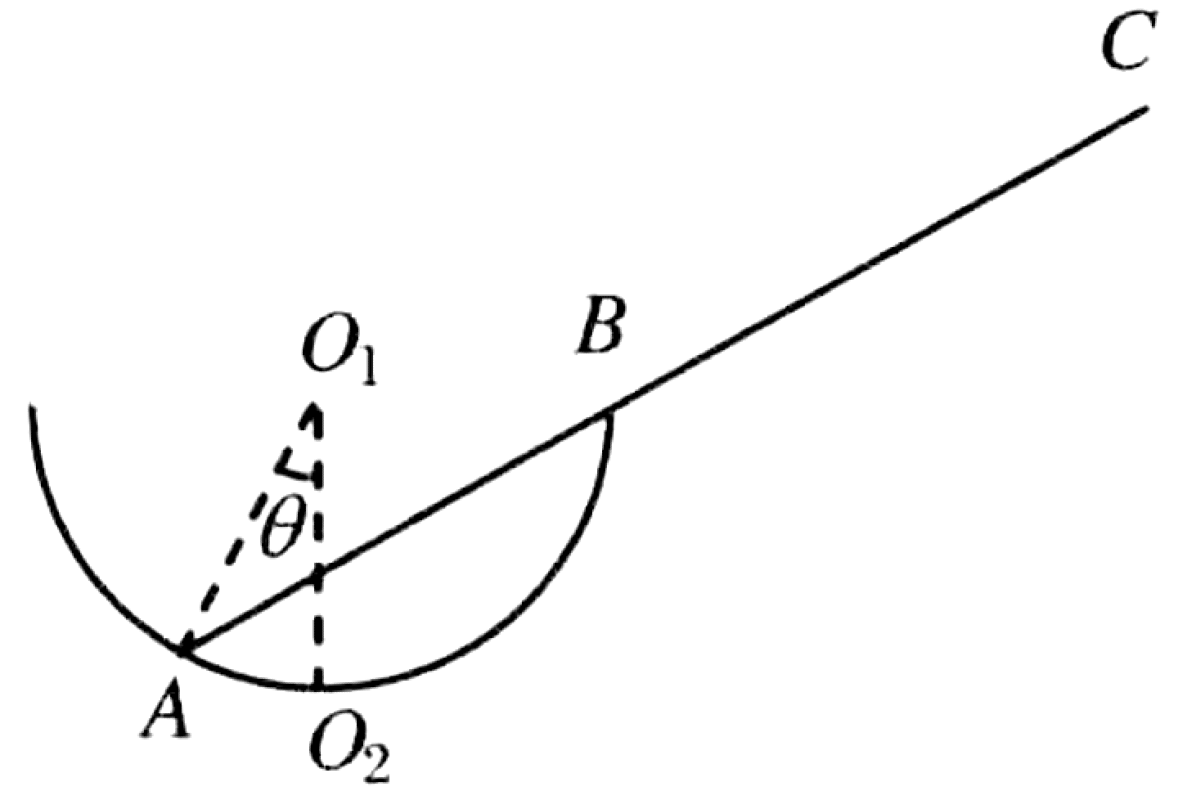
P0738-problem-1
Hints
Hint 1: Use ICR
Hint 2: The velocity of point B on the stick should be along the stick
The ratio of the lengths AB to BC is given by:
$$\frac{AB}{BC} = \frac{\cos\alpha}{\sqrt{3 + \cos^2\alpha}}$$where $\alpha = 45^\circ - \frac{\theta}{2}$. Substituting for $\alpha$, the ratio is:
$$\frac{AB}{BC} = \frac{\cos(45^\circ - \theta/2)}{\sqrt{3 + \cos^2(45^\circ - \theta/2)}}$$The solution uses the concept of the Instantaneous Center of Rotation (ICR) for the rod AC. The velocity $v_P$ of any point P on a rigid body is related to its distance $r_{IP}$ from the ICR (denoted by I) and the angular velocity $\omega$ of the body by $v_P = \omega \cdot r_{IP}$.
-
Locating the ICR (I) The ICR is found by the intersection of perpendiculars to the velocity vectors of two points on the body.
- The velocity of end A, $\vec{v}_A$, is tangent to the circular path of radius $R$ centered at $O_1$. Therefore, $\vec{v}_A$ is perpendicular to the radius $O_1A$. The ICR must lie on the line containing the segment $O_1A$.
- Point B on the rod slides along the fixed rim. The velocity of a point on a body sliding over a fixed point must be directed along the body. Thus, the velocity of B, $\vec{v}_B$, is along the rod AC. The perpendicular to $\vec{v}_B$ is a line through B perpendicular to the rod AC.
- Therefore, the ICR (I) is the intersection of the line extending $O_1A$ and the line perpendicular to the rod AC at point B. This implies that $\triangle IBA$ is a right-angled triangle, with the right angle at B.
-
Using the Velocity Condition The problem states that $v_A = v_C/2$. Using the ICR relation $v = \omega \cdot r$:
$$\omega \cdot IA = \frac{1}{2} (\omega \cdot IC) \implies IA = \frac{1}{2} IC$$Squaring both sides gives $IA^2 = \frac{1}{4} IC^2$.
-
Geometric Derivation Since I, B, and the line AC form a right angle at B, we can apply the Pythagorean theorem to triangles $\triangle IBA$ and $\triangle ICB$:
$$IA^2 = IB^2 + AB^2$$ $$IC^2 = IB^2 + BC^2$$Substitute these into the squared velocity condition:
$$IB^2 + AB^2 = \frac{1}{4} (IB^2 + BC^2)$$ $$4IB^2 + 4AB^2 = IB^2 + BC^2$$ $$3IB^2 = BC^2 - 4AB^2$$Now, we express $IB$ in terms of the rod's geometry. In the right-angled triangle $\triangle IBA$, let $\alpha = \angle IAB$. Then:
$$IB = AB \tan\alpha$$Substituting this into the previous equation:
$$3(AB \tan\alpha)^2 = BC^2 - 4AB^2$$ $$3AB^2 \tan^2\alpha + 4AB^2 = BC^2$$ $$AB^2 (3\tan^2\alpha + 4) = BC^2$$The desired ratio is:
$$\frac{AB^2}{BC^2} = \frac{1}{3\tan^2\alpha + 4}$$ $$\frac{AB}{BC} = \frac{1}{\sqrt{3\tan^2\alpha + 4}}$$This can be rewritten in terms of $\cos\alpha$:
$$\frac{AB}{BC} = \frac{1}{\sqrt{3\frac{\sin^2\alpha}{\cos^2\alpha} + 4}} = \frac{|\cos\alpha|}{\sqrt{3\sin^2\alpha + 4\cos^2\alpha}} = \frac{|\cos\alpha|}{\sqrt{3(1-\cos^2\alpha) + 4\cos^2\alpha}} = \frac{|\cos\alpha|}{\sqrt{3 + \cos^2\alpha}}$$ -
Finding the angle $\alpha$ The angle $\alpha = \angle IAB$ is the same as $\angle O_1AB$. Consider the triangle $\triangle O_1AB$.
- $O_1A = R$ (radius of hemisphere).
- $O_1$ is in the plane of the rim, so $O_1B=R$ (radius of the rim).
- Thus, $\triangle O_1AB$ is an isosceles triangle with $\angle O_1AB = \angle O_1BA = \alpha$.
- The angle $\angle AO_1B$ is the angle between the vector $\vec{O_1A}$ (at angle $\theta$ from the vertical) and $\vec{O_1B}$ (which is horizontal). This angle is $\angle AO_1B = 90^\circ + \theta$.
- The sum of angles in $\triangle O_1AB$ is $180^\circ$:
-
Final Expression Substituting $\alpha$ into the expression for the ratio, we find that the ratio depends on the instantaneous angle $\theta$. Since $\alpha$ must be an internal angle of a physical triangle configuration, $\cos\alpha > 0$.
$$\frac{AB}{BC} = \frac{\cos(45^\circ - \theta/2)}{\sqrt{3 + \cos^2(45^\circ - \theta/2)}}$$