Source: Physics Competition - Mechanics
Problem Sets:
Problem
As shown in Figure, circle A with radius $R_1$ rotates about its fixed center $O_1$ with constant angular velocity $\omega_1$. Circle B with radius $R_2$ rolls without slipping on the outside of circle A, with constant angular velocity $\omega_2$ about its own center $O_2$.
- Find the angular velocity $\omega$ of the line connecting the centers, $O_1O_2$.
- Find the time $t_1$ required for circle B to roll once around circle A.
- Find the time $t_2$ required for circle B to complete one revolution relative to circle A.
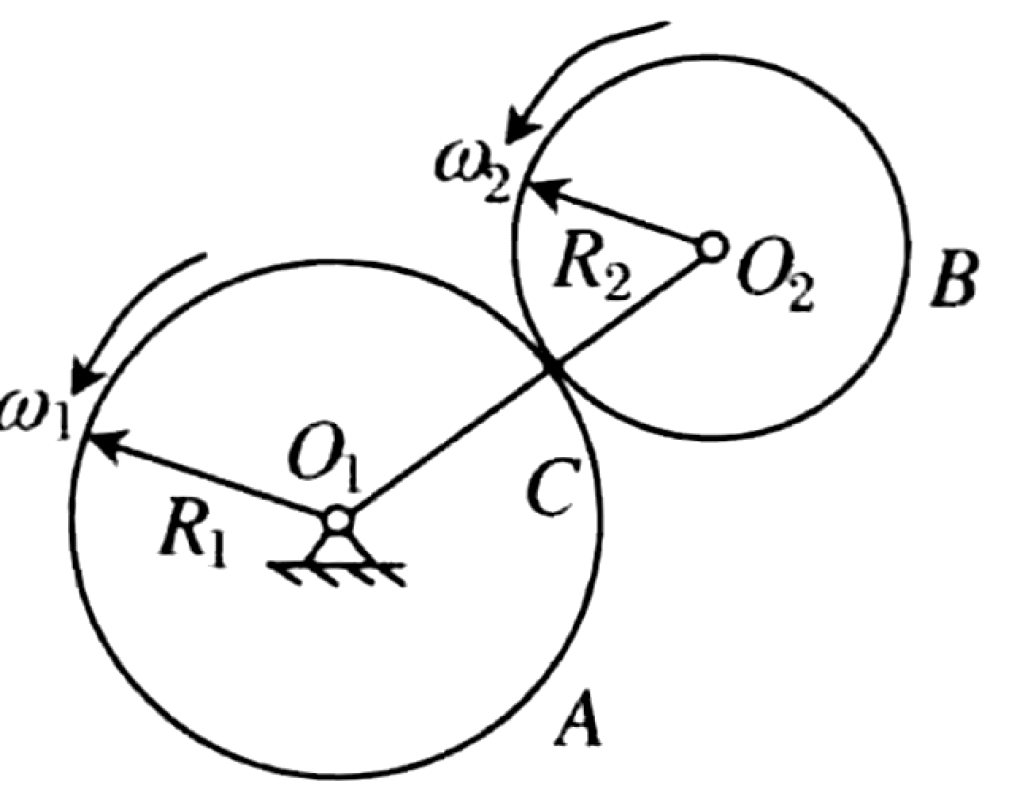
P0733-problem-1
[Q1] $\omega = \frac{\omega_1 R_1 + \omega_2 R_2}{R_1 + R_2}$ [Q2] $t_1 = \frac{2\pi (R_1 + R_2)}{\omega_1 R_1 + \omega_2 R_2}$ [Q3] $t_2 = \frac{2\pi (R_1 + R_2)}{R_2 |\omega_2 - \omega_1|}$
The no-slip condition requires the tangential velocities at the contact point $C$ to be equal for both circles. The velocity of point $C$ on circle A is $v_{CA} = \omega_1 R_1$. The center of circle B, $O_2$, revolves around $O_1$ with angular velocity $\omega$. The distance $|O_1O_2| = R_1 + R_2$. The velocity of the center of circle B is $v_{O2} = \omega (R_1 + R_2)$. The velocity of point $C$ on circle B combines its center's velocity and its rotational velocity: $v_{CB} = v_{O2} - \omega_2 R_2 = \omega (R_1 + R_2) - \omega_2 R_2$. Equating velocities at the contact point, $v_{CA} = v_{CB}$:
$$\omega_1 R_1 = \omega (R_1 + R_2) - \omega_2 R_2$$[Q1] Solving for $\omega$:
$$\omega (R_1 + R_2) = \omega_1 R_1 + \omega_2 R_2 \implies \omega = \frac{\omega_1 R_1 + \omega_2 R_2}{R_1 + R_2}$$[Q2] The time $t_1$ for B to circle A once is the period of revolution of the line $O_1O_2$.
$$t_1 = \frac{2\pi}{\omega} = \frac{2\pi (R_1 + R_2)}{\omega_1 R_1 + \omega_2 R_2}$$[Q3] The time $t_2$ for B to complete one revolution relative to A is the period of this motion in A's reference frame. The relative angular velocity of the line $O_1O_2$ with respect to circle A is $\omega_{rel} = \omega - \omega_1$.
$$\omega_{rel} = \frac{\omega_1 R_1 + \omega_2 R_2}{R_1 + R_2} - \omega_1 = \frac{\omega_2 R_2 - \omega_1 R_2}{R_1 + R_2} = \frac{R_2(\omega_2 - \omega_1)}{R_1 + R_2}$$The time is the inverse of the magnitude of this relative angular velocity:
$$t_2 = \frac{2\pi}{|\omega_{rel}|} = \frac{2\pi (R_1 + R_2)}{|R_2(\omega_2 - \omega_1)|}$$