Source: Physics Competition - Mechanics
Problem Sets:
Problem
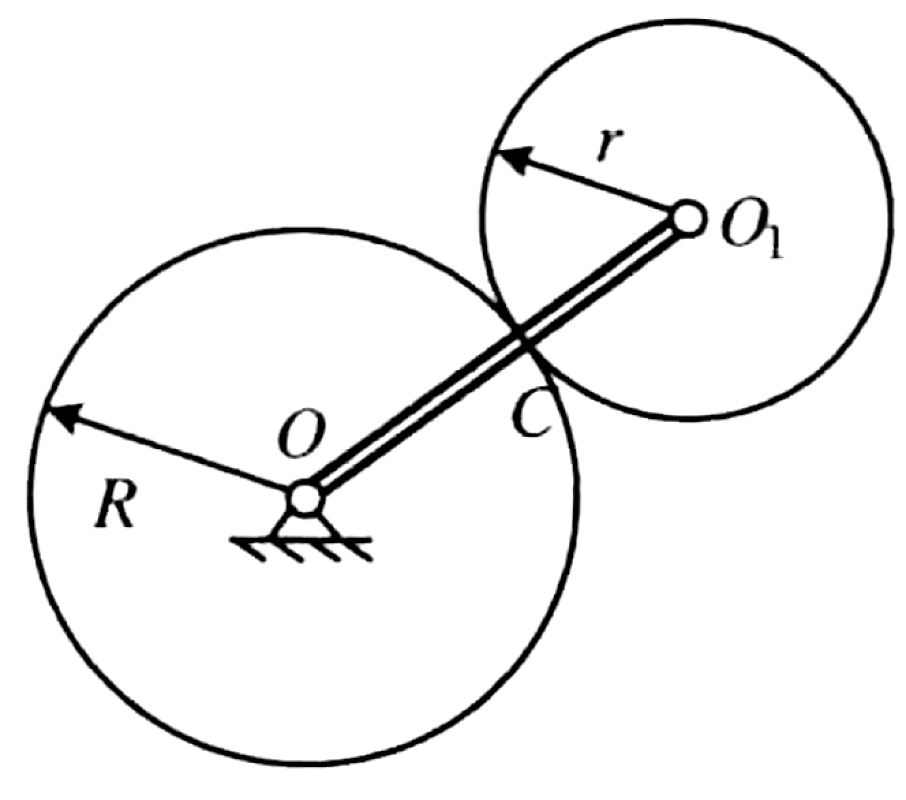
As shown in Figure, a moving gear with radius $r$ is driven by a crank arm $OO_1$ to roll along a fixed gear with radius $R$. The crank arm rotates about the axis $O$ with a constant angular velocity $\omega_0$.
P0732-problem-1
The motion of the moving gear is a combination of the translation of its center $O_1$ and rotation about $O_1$. The velocity of the center $O_1$ is determined by the rotation of the crank arm $OO_1$, which has a length of $R+r$.
$$v_{O1} = \omega_0 (R+r)$$For rolling without slipping, the velocity of the point of contact $C$ on the moving gear must be zero, as it is in contact with the fixed gear. The velocity of point $C$ is the sum of the center's translational velocity and the velocity due to rotation. Let $\omega$ be the angular velocity of the moving gear.
$$v_C = v_{O1} - \omega r$$Setting $v_C = 0$ for the no-slip condition:
$$v_{O1} - \omega r = 0 \implies \omega_0 (R+r) - \omega r = 0$$Solving for $\omega$:
$$\omega = \frac{\omega_0 (R+r)}{r}$$