Source: Physics Competition - Mechanics
Problem Sets:
Problem
As shown in the figure, disk B with radius $R_2$ rolls without slipping inside a stationary circular disk A with radius $R_1$. The disk A rotates around the center $O_1$ with a constant angular velocity $\omega_1$. Disk B rotates about its own center $O_2$ with angular velocity $\omega_2$.
- Find the angular velocity $\omega$ of the line connecting the centers, $O_1O_2$.
- Find the time $t_1$ required for disk B to roll one full revolution around circle A.
- Find the time $t_2$ required for disk B to complete one revolution around $O_1$ of circle A relative to circle A.
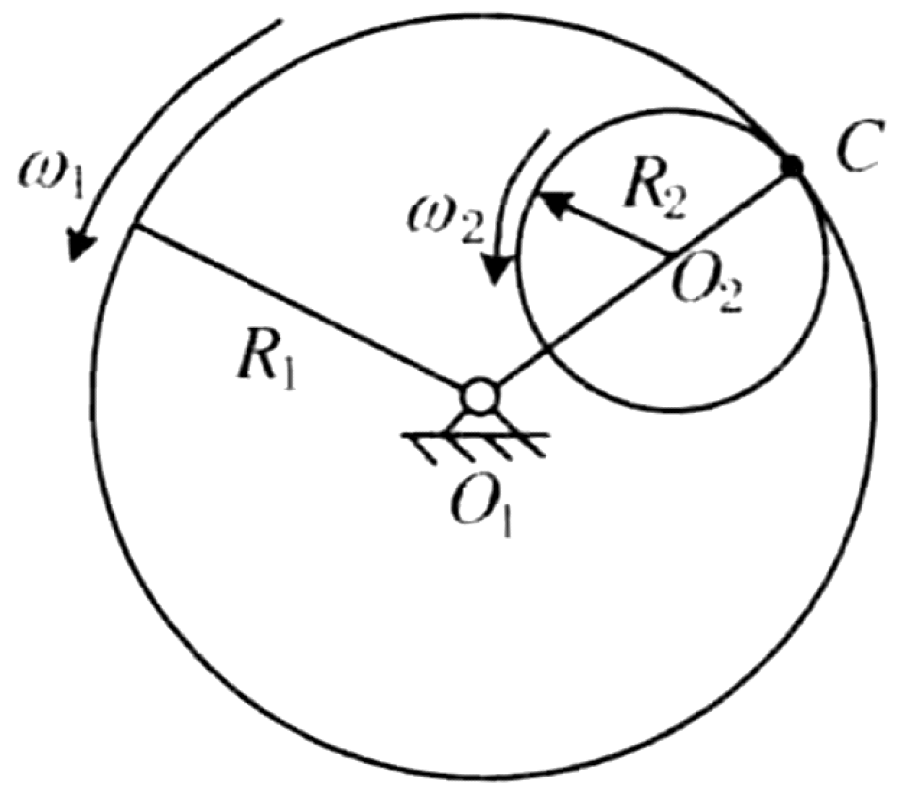
P0731-problem-1
[Q1] The angular velocity of the line $O_1O_2$ is:
$$ \omega = \frac{\omega_1 R_1 - \omega_2 R_2}{R_1 - R_2} $$[Q2] The time for disk B to roll one full revolution around circle A is:
$$ t_1 = 2\pi \left| \frac{R_1 - R_2}{\omega_1 R_1 - \omega_2 R_2} \right| $$[Q3] The time for disk B to complete one revolution around $O_1$ relative to circle A is:
$$ t_2 = 2\pi \left| \frac{R_1 - R_2}{(\omega_1 - \omega_2) R_2} \right| $$Key Concept: No-Slip Condition The problem is solved by applying the no-slip condition at the contact point C between disk A and disk B. This condition states that the absolute velocity of the point C on disk A is equal to the absolute velocity of the point C on disk B.
$$ \vec{v}_C^A = \vec{v}_C^B $$We will use a scalar approach, assuming the clockwise direction shown in the figure is positive for all angular velocities.
Derivation Let $\omega$ be the angular velocity of the arm $O_1O_2$.
- The velocity of the contact point C on the outer disk A is due to its rotation about $O_1$: $$v_C^A = \omega_1 R_1$$
- The velocity of the contact point C on the inner disk B is the sum of the translational velocity of its center $O_2$ and the rotational velocity of point C about $O_2$.
- The center $O_2$ moves in a circle of radius $(R_1 - R_2)$ about $O_1$. Its velocity is: $$v_{O_2} = \omega (R_1 - R_2)$$
- The velocity of point C relative to $O_2$ is due to disk B's rotation: $$v_{C/O_2} = \omega_2 R_2$$
- As per the diagram, at point C, both velocities $v_{O_2}$ and $v_{C/O_2}$ are in the same direction. So, the total velocity of C on disk B is: $$v_C^B = v_{O_2} + v_{C/O_2} = \omega (R_1 - R_2) + \omega_2 R_2$$
- Applying the no-slip condition $v_C^A = v_C^B$: $$\omega_1 R_1 = \omega (R_1 - R_2) + \omega_2 R_2$$
[Q1] Angular velocity $\omega$ of the line $O_1O_2$ Solving the no-slip equation for $\omega$:
$$ \omega (R_1 - R_2) = \omega_1 R_1 - \omega_2 R_2 $$ $$ \omega = \frac{\omega_1 R_1 - \omega_2 R_2}{R_1 - R_2} $$[Q2] Time $t_1$ for one revolution around circle A This is the period of rotation of the arm $O_1O_2$ in the fixed frame. The period $T$ is related to angular velocity by $T = 2\pi/|\omega|$.
$$ t_1 = \frac{2\pi}{|\omega|} = 2\pi \left| \frac{R_1 - R_2}{\omega_1 R_1 - \omega_2 R_2} \right| $$[Q3] Time $t_2$ for one revolution relative to circle A This requires finding the angular velocity of the arm $O_1O_2$ relative to the rotating disk A, which is $\omega_{rel} = \omega - \omega_1$.
$$ \omega_{rel} = \frac{\omega_1 R_1 - \omega_2 R_2}{R_1 - R_2} - \omega_1 $$ $$ \omega_{rel} = \frac{(\omega_1 R_1 - \omega_2 R_2) - \omega_1(R_1 - R_2)}{R_1 - R_2} $$ $$ \omega_{rel} = \frac{\omega_1 R_1 - \omega_2 R_2 - \omega_1 R_1 + \omega_1 R_2}{R_1 - R_2} $$ $$ \omega_{rel} = \frac{(\omega_1 - \omega_2) R_2}{R_1 - R_2} $$The time $t_2$ is the period corresponding to this relative angular velocity:
$$ t_2 = \frac{2\pi}{|\omega_{rel}|} = 2\pi \left| \frac{R_1 - R_2}{(\omega_1 - \omega_2) R_2} \right| $$