Source: Physics Competition - Mechanics
Problem Sets:
Problem
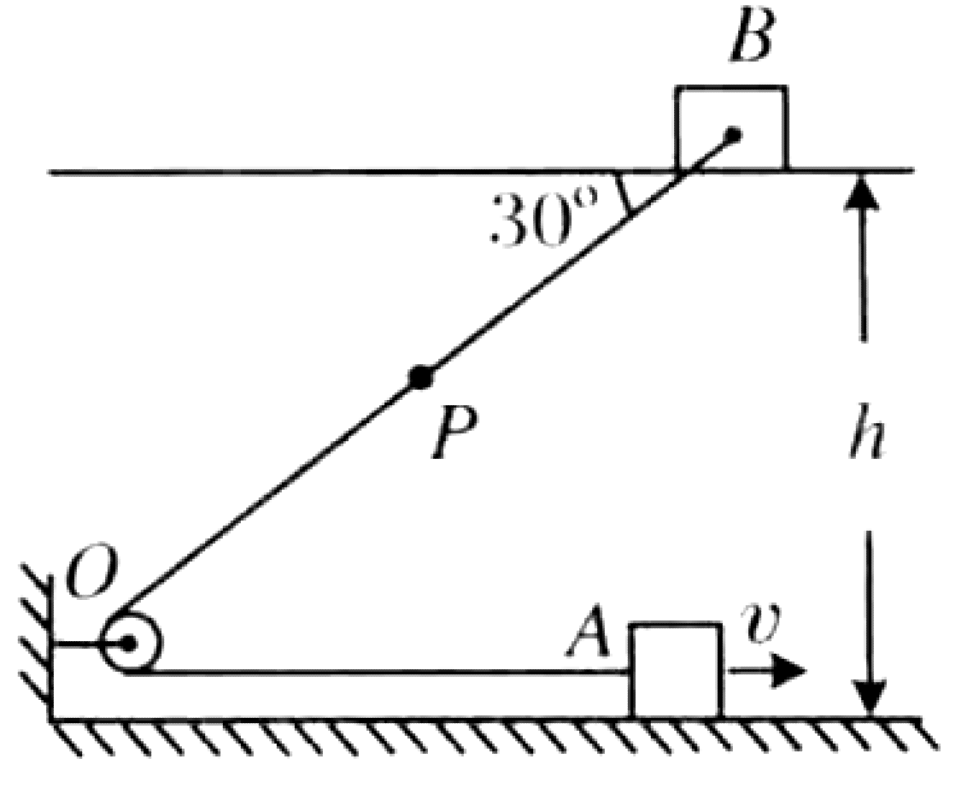
As shown in the figure, two horizontal tracks in the same vertical plane are separated by a distance $h$. On the tracks are two objects A and B, connected by a light, inextensible string passing over a fixed pulley O. Object A moves on the lower track at a constant speed $v$. At the instant the string segment BO makes an angle of $30^\circ$ with the horizontal, a small water droplet P, initially at the midpoint of BO, detaches from the string.
- Find the magnitude of the droplet's velocity and the angle it makes with the string BO at the moment of detachment.
- Find the time it takes for the droplet to fall to the lower track.
P0729-problem-1
Hints
Hint 1: Decompose the motion of P into along the rope and perpendicular to the rope
Hint 2: Determine the two components of the motion of point P on the rope from the motion analysis of Block B
[Q1] The magnitude of the droplet's velocity is:
$$|v_P| = \frac{\sqrt{39}}{6}v$$The angle $\alpha$ the velocity makes with the string BO is:
$$\alpha = \arctan\left(\frac{\sqrt{3}}{6}\right)$$[Q2] The time it takes for the droplet to fall to the lower track is:
$$t = \frac{-v + \sqrt{v^2 + 16gh}}{4g}$$The motion of the droplet P at the moment of detachment is a superposition of two motions:
- Motion along the string BO.
- Motion perpendicular to the string BO due to the string's rotation about the pulley O.
[Q1] Droplet's Velocity
-
Velocity Component Along the String ($v_{||}$) As block A moves to the right with speed $v$, the length of string segment OA increases at a rate $v$. Since the total string length is constant, the length of segment OB must decrease at a rate $v$. This means every point on the string segment BO, including P, has a velocity component of magnitude $v$ directed along the string towards O.
$$v_{P,||} = v$$ -
Velocity Component Perpendicular to the String ($v_{\perp}$) The motion of block B is purely horizontal. Its velocity component along the string is $v_{B,||} = v_B \cos\theta$. Since this component must be responsible for the shortening of the string, $v_{B,||} = v$. Therefore, the speed of block B is $v_B = v / \cos\theta$. The velocity component of B perpendicular to the string is due to the rotation of segment BO about O. Its magnitude is $v_{B,\perp} = v_B \sin\theta = (v/\cos\theta)\sin\theta = v\tan\theta$. The droplet P is at the midpoint of BO. Its distance from the pivot O is half that of B. Thus, its perpendicular (tangential) speed is half of B's.
$$v_{P,\perp} = \frac{1}{2} v_{B,\perp} = \frac{v}{2}\tan\theta$$ -
Resultant Velocity of the Droplet The two components $v_{P,||}$ and $v_{P,\perp}$ are orthogonal. The magnitude of the droplet's total velocity $v_P$ is:
$$|v_P| = \sqrt{v_{P,||}^2 + v_{P,\perp}^2} = \sqrt{v^2 + \left(\frac{v}{2}\tan\theta\right)^2} = v\sqrt{1 + \frac{1}{4}\tan^2\theta}$$At $\theta = 30^\circ$:
$$|v_P| = v\sqrt{1 + \frac{1}{4}\tan^2 30^\circ} = v\sqrt{1 + \frac{1}{4}\left(\frac{1}{\sqrt{3}}\right)^2} = v\sqrt{1 + \frac{1}{12}} = \frac{\sqrt{39}}{6}v$$The angle $\alpha$ the velocity vector makes with the string BO is:
$$\tan\alpha = \frac{v_{P,\perp}}{v_{P,||}} = \frac{\frac{v}{2}\tan\theta}{v} = \frac{1}{2}\tan\theta$$At $\theta = 30^\circ$:
$$\tan\alpha = \frac{1}{2}\tan 30^\circ = \frac{1}{2\sqrt{3}} = \frac{\sqrt{3}}{6}$$ $$\alpha = \arctan\left(\frac{\sqrt{3}}{6}\right)$$
[Q2] Time of Flight
-
Initial Position and Velocity The droplet P detaches from the midpoint of BO. Its initial height above the lower track is $y_0 = \frac{h}{2}$. To find the time of flight, we need the initial vertical component of the droplet's velocity, $v_{Py}$. We set up a coordinate system with O at the origin, the lower track on the x-axis, and the upper track at $y=h$. The decrease in length of OB means $\theta$ increases (counter-clockwise rotation).
- The vertical component of $v_{P,||}$ (directed towards O) is downward: $v_{Py,||} = -v_{P,||} \sin\theta = -v\sin\theta$.
- The vertical component of $v_{P,\perp}$ (due to CCW rotation) is upward: $v_{Py,\perp} = v_{P,\perp} \cos\theta = \left(\frac{v}{2}\tan\theta\right)\cos\theta = \frac{v}{2}\sin\theta$. The total initial vertical velocity is:
-
Equation of Motion The vertical motion of the droplet is described by $y(t) = y_0 + v_{Py}t - \frac{1}{2}gt^2$. We need to find the time $t$ when the droplet hits the lower track, $y(t)=0$.
$$0 = \frac{h}{2} - \left(\frac{v}{2}\sin\theta\right)t - \frac{1}{2}gt^2$$Multiplying by 2 and rearranging gives a quadratic equation for $t$:
$$gt^2 + (v\sin\theta)t - h = 0$$Solving for $t$ (and taking the positive root):
$$t = \frac{-v\sin\theta + \sqrt{(v\sin\theta)^2 + 4gh}}{2g}$$ -
Final Calculation Substituting $\theta = 30^\circ$ ($\sin 30^\circ = 1/2$):
$$t = \frac{-v(1/2) + \sqrt{v^2(1/2)^2 + 4gh}}{2g} = \frac{-v/2 + \sqrt{v^2/4 + 4gh}}{2g}$$ $$t = \frac{-v + \sqrt{v^2 + 16gh}}{4g}$$