Source: Physics Competition - Mechanics
Problem Sets:
Problem
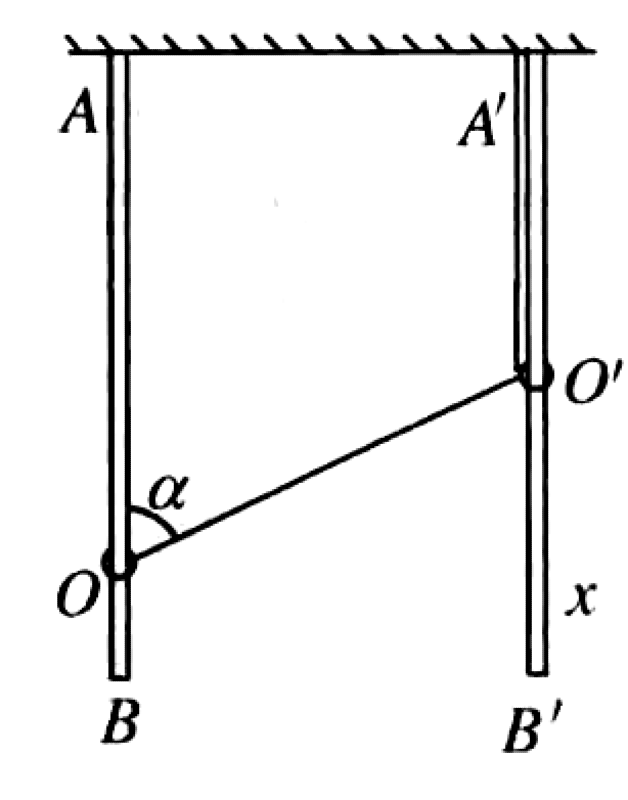
As shown in Figure, two small rings, O and O', are on fixed vertical rods AB and A'B', respectively. An inextensible string passes through ring O', with its ends tied to a fixed point A' and ring O. Ring O' moves downwards with a constant speed $v$.
P0725-problem-1
The speed of ring O is:
$$v_O = v \frac{1 + \cos \alpha}{\cos \alpha}$$[Q1] Find the speed of ring O, $v_O$, at the instant when the angle between the line segment OO' and the vertical rode is $\alpha$.
The core physical principle governing this system is the constraint that the total length of the inextensible string is constant. Let the total length of the string be $L$. The string consists of two segments: from A' to O' (length $l_1$) and from O' to O (length $l_2$).
$$L = l_1 + l_2 = \text{constant}$$Differentiating with respect to time, the rate of change of the total length is zero:
$$\frac{dL}{dt} = \frac{dl_1}{dt} + \frac{dl_2}{dt} = 0$$Let's analyze the rate of change of each segment's length:
-
Segment A'O': Ring O' moves downwards with a constant speed $v$. Since A' is a fixed point, the length $l_1 = A'O'$ increases at a rate equal to the speed of O'.
$$\frac{dl_1}{dt} = v$$ -
Segment O'O: The length $l_2 = O'O$ changes due to the motion of both ring O and ring O'. The rate of change of $l_2$ is the difference of the velocity components of O' and O along the line connecting them.
- The velocity of ring O' is $\vec{v}$ (downwards). Its component along the line O'O is $v \cos \alpha$. This component acts to increase the length $l_2$.
- The velocity of ring O is $\vec{v}_O$ (downwards). Its component along the line O'O is $v_O \cos \alpha$. This component acts to decrease the length $l_2$.
Therefore, the net rate of change of the length $l_2$ is:
$$\frac{dl_2}{dt} = v \cos \alpha - v_O \cos \alpha$$
Now, we substitute these rates back into the constraint equation:
$$\frac{dl_1}{dt} + \frac{dl_2}{dt} = 0$$ $$v + (v \cos \alpha - v_O \cos \alpha) = 0$$Solving for the speed of ring O, $v_O$:
$$v(1 + \cos \alpha) = v_O \cos \alpha$$ $$v_O = v \frac{1 + \cos \alpha}{\cos \alpha}$$This can also be expressed as $v_O = v(1 + \sec \alpha)$.