Source: Physics Competition - Mechanics
Problem Sets:
Problem
A light rod AD rests on a semi-cylinder of radius $R$ and a horizontal ground surface, as shown in Figure. End A is on the ground, and the rod is tangent to the cylinder at point B. The angle between the cylinder radius OB and the vertical is $\theta$.
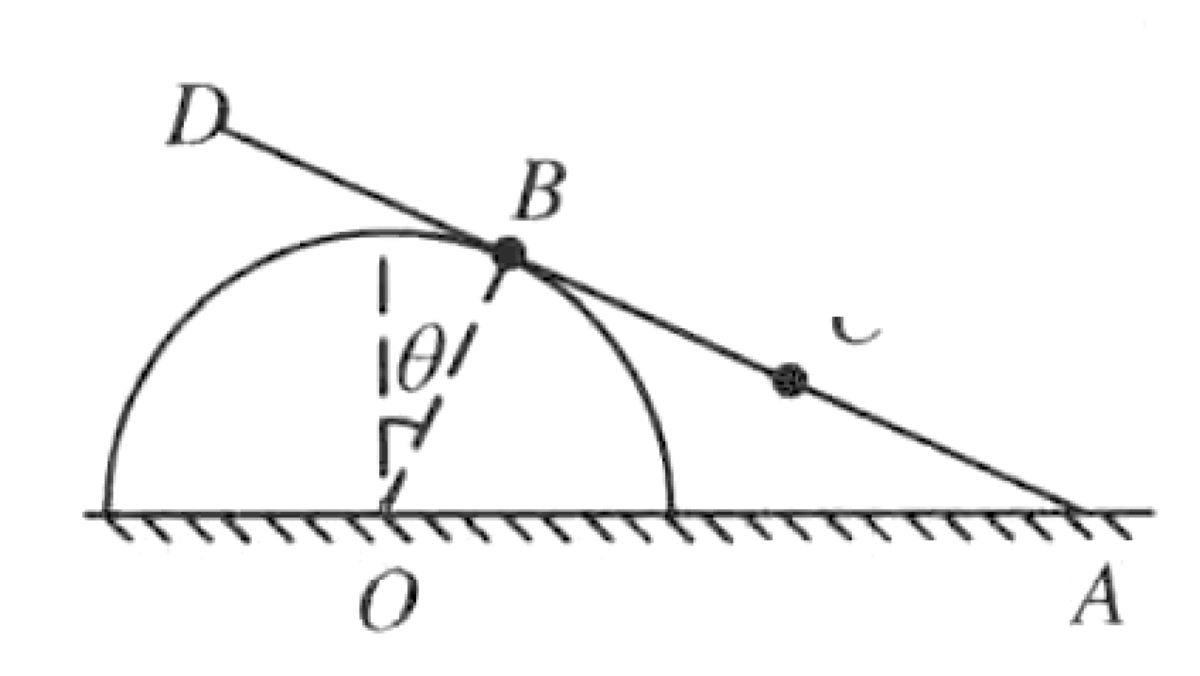
P0724-problem-1
The motion of the rigid rod AB can be described as an instantaneous rotation about an Instantaneous Center of Rotation (ICR), denoted as P.
The velocity of point A, $\vec{v}_A$, is horizontal. Therefore, the ICR must lie on the vertical line passing through A. The velocity of the point on the rod at B, $\vec{v}_B$, is tangent to the stationary cylinder. Therefore, the ICR must lie on the line extending from the radius OB. The ICR, P, is the intersection of these two lines.
Let the origin be the center of the semi-cylinder, O. The ground is the x-axis. The coordinates are:
$O=(0,0)$, $B=(R\sin\theta, R\cos\theta)$.The rod is tangent to the circle at B, so its slope is $-\tan\theta$. The equation of the line representing the rod is $y - R\cos\theta = -\tan\theta(x - R\sin\theta)$. Point A is on the x-axis ($y=0$), so its x-coordinate is $x_A = R/\sin\theta$. Thus, $A=(R/\sin\theta, 0)$. The ICR P has $x_P = x_A = R/\sin\theta$. It lies on the line OB, whose equation is $y = (\cot\theta)x$. So, $y_P = (R/\sin\theta)\cot\theta = R\cos\theta/\sin^2\theta$.
The speed of any point on the rod is proportional to its distance from the ICR, P.
$$v = \omega \cdot d_{P}$$The ratio of speeds is the ratio of distances from P:
$$\frac{v_C}{v_A} = \frac{PC}{PA}$$The distances are calculated as:
$PA = y_P = R\cos\theta/\sin^2\theta$.The midpoint C of AB has coordinates $C = (\frac{x_A+x_B}{2}, \frac{y_A+y_B}{2}) = (\frac{R(1+\sin^2\theta)}{2\sin\theta}, \frac{R\cos\theta}{2})$. The square of the distance PC is:
$$PC^2 = (x_C-x_P)^2 + (y_C-y_P)^2$$ $$PC^2 = \left(\frac{-R\cos^2\theta}{2\sin\theta}\right)^2 + \left(\frac{R\cos\theta(\sin^2\theta-2)}{2\sin^2\theta}\right)^2 = \frac{R^2\cos^2\theta}{4\sin^4\theta}(4-3\sin^2\theta)$$The ratio of the squared speeds is:
$$\left(\frac{v_C}{v_A}\right)^2 = \frac{PC^2}{PA^2} = \frac{\frac{R^2\cos^2\theta}{4\sin^4\theta}(4-3\sin^2\theta)}{(\frac{R\cos\theta}{\sin^2\theta})^2} = \frac{4-3\sin^2\theta}{4}$$Taking the square root gives the final ratio.