Source: Others
Problem
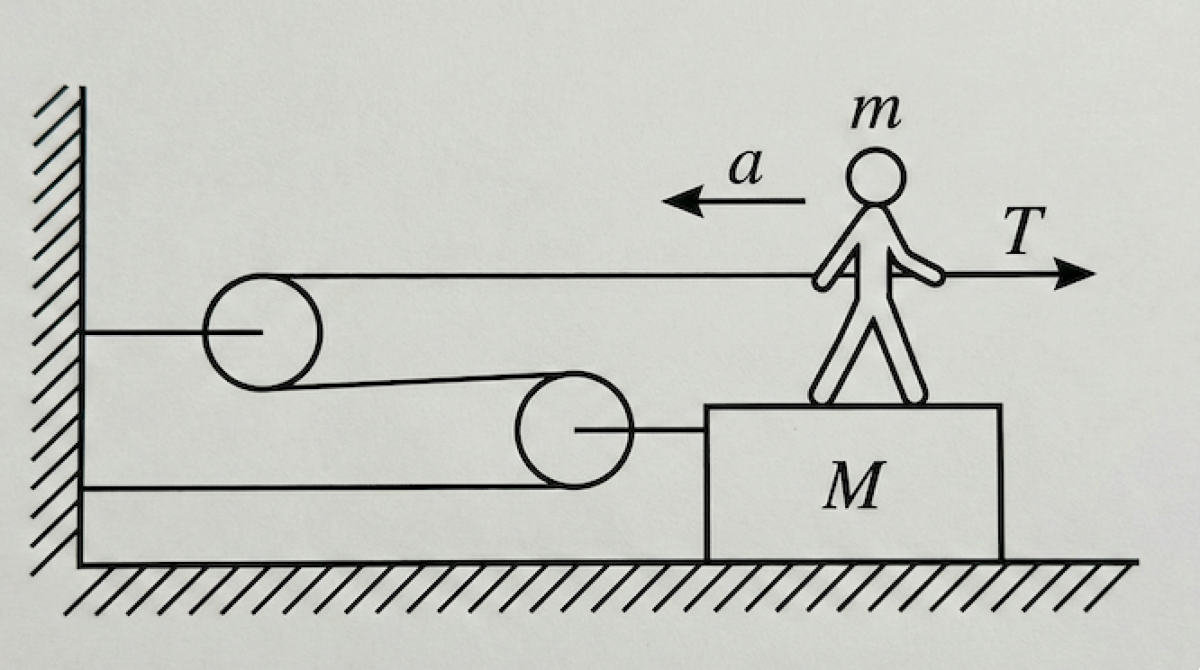
A block of mass $M$ rests on a smooth, frictionless horizontal floor. A man of mass $m$ stands on top of the block. A system of two pulleys is used to accelerate the block:
- One pulley is fixed to the wall (left).
- One pulley is attached to the front of the block.
- A massless, inextensible rope is anchored to the wall, passes over the block's pulley, then back over the wall's pulley, and finally into the hands of the man.
The rope segments are all horizontal. The coefficient of static friction between the man's shoes and the top of the block is $\mu_s$. The man pulls the rope with a tension force $T$, causing the entire system (block + man) to accelerate towards the wall (to the left).
- Part A: Ideal Pulleys: Assume the pulleys are massless and frictionless.
- Part B: Real Pulleys: Assume both pulleys are solid disks with mass $M_p$, radius $R$, and moment of inertia $I$.
- Kinematic Constraint: If the man pulls a length $L$ of rope through his hands relative to his position on the block, what is the displacement $d$ of the block relative to the ground?
- Ideal Dynamics (Part A): Determine the acceleration $a$ of the system (man + block) in terms of $T$, $m$, and $M$.
- The "Slippery Shoes" Limit (Part A): Determine the maximum tension $T_{max}$ the man can apply before his shoes slip on the block. Discuss how the direction of the required friction force depends on the ratio of the masses $M$ and $m$.
- Kinetic Energy (Part A): What is final kinetic energy of the system after the block has moved a distance $d$ from rest?
- Non-Ideal Dynamics(Part B): Derive the new acceleration $a'$ of the system, taking into account the moment of inertia $I$ of both pulleys. Express your answer in terms of $T$, $m$, $M$, $I$, and $R$.
- Friction Comparison(Part B): Does the presence of heavy pulleys (non-zero $I$) increase or decrease the static friction force required between the man's shoes and the block to prevent slipping (compared to the ideal case in Q3)? Justify your answer physically.
P0720-problem-1
[Q1] $d = \frac{L}{3}$ [Q2] $a = \frac{3T}{m+M}$ [Q3] $T_{max} = \frac{\mu_s mg(m+M)}{|2m-M|}$. The friction force on the man is to the left if $2m > M$ and to the right if $2m < M$. [Q4] $K_f = 3Td$ [Q5] $a' = \frac{3T}{m+M+M_p + \frac{5I}{R^2}}$ [Q6] The effect depends on the mass ratio. For a given tension $T$, the required friction force magnitude increases if $2m < M$ and decreases if $2m > M$. This is because the pulleys add inertia primarily to the block, making the overall system more sluggish.
Here is the solution to the physics problem.
[Q1] Kinematic Constraint Let the position of the block from the wall be $x_B$. The man is on the block, so his position is also $x_M = x_B$. Let the wall be at $x=0$. The total length of the rope from the wall anchor to the man's hands, $S$, is composed of three segments:
- Anchor to block pulley: length $x_B$.
- Block pulley to wall pulley: length $x_B$.
- Wall pulley to man's hands: length $x_B$. So, the total active rope length is $S = 3x_B$. When the man pulls a length $L$ of rope, the length $S$ decreases by $L$.
The displacement of the block is $d = -\Delta x_B$ (since it moves left, in the negative $x$ direction if $x$ is measured from the wall).
$$3(-d) = -L \implies L=3d$$Therefore, the displacement of the block is $d = L/3$.
[Q2] Ideal Dynamics (Part A) Consider the man and block as a single system of total mass $(m+M)$. We identify the external horizontal forces acting on this system. The rope is external to the system.
- The rope pulls the man to the left with tension $T$.
- Two segments of the rope pull on the block's pulley to the left, each with tension $T$. The total force on the block is $2T$. The total external force on the system is $F_{ext} = T + 2T = 3T$ to the left. Applying Newton's second law, $F_{ext} = (m+M)a$:
[Q3] The "Slippery Shoes" Limit (Part A) Consider the man as an isolated system. The horizontal forces on him are the pull from the rope, $T$ (left), and the static friction from the block, $f_s$. Let the direction of acceleration (left) be positive. Newton's second law for the man is:
$$T + f_s = ma$$Solving for the required friction force $f_s$:
$$f_s = ma - T$$Substitute the expression for acceleration $a$ from Q2:
$$f_s = m\left(\frac{3T}{m+M}\right) - T = T\left(\frac{3m}{m+M} - 1\right) = T\left(\frac{2m-M}{m+M}\right)$$The direction of the friction force on the man depends on the sign of $(2m-M)$:
- If $2m > M$, $f_s > 0$. Friction is to the left, in the direction of motion.
- If $2m < M$, $f_s < 0$. Friction is to the right, opposing the pull $T$.
- If $2m = M$, $f_s = 0$. No friction is required.
For the man not to slip, $|f_s| \le \mu_s N$. The normal force $N$ between the man and the block is $mg$.
$$|f_s| \le \mu_s mg$$ $$T \frac{|2m-M|}{m+M} \le \mu_s mg$$The maximum tension $T_{max}$ is:
$$T_{max} = \frac{\mu_s mg(m+M)}{|2m-M|}$$[Q4] Kinetic Energy (Part A) The system starts from rest. By the work-energy theorem, the final kinetic energy $K_f$ is equal to the net work done on the system, $W_{net}$. The total external force on the system is $F_{ext}=3T$. This force acts over the displacement $d$ of the system.
$$W_{net} = F_{ext} \cdot d = 3Td$$Alternatively, using kinematics: $K_f = \frac{1}{2}(m+M)v_f^2$. With constant acceleration, $v_f^2 = 2ad$.
$$K_f = \frac{1}{2}(m+M)(2ad) = (m+M)ad$$Substituting $a = \frac{3T}{m+M}$:
$$K_f = (m+M)\left(\frac{3T}{m+M}\right)d = 3Td$$[Q5] Non-Ideal Dynamics (Part B) With massive pulleys, the tensions in the three rope segments are different. Let them be $T_1$ (anchor-P2), $T_2$ (P2-P1), and $T$ (P1-man). Let $a'$ be the new acceleration. The problem can be solved using either force/torque analysis or the work-energy theorem. The energy method is more direct. The work done by the man pulling a length of rope $L$ with force $T$ is $W_{in} = TL$. This work increases the system's kinetic energy. From Q1, $L=3d$. So, $W_{in} = 3Td$. The final kinetic energy $K_f$ has translational and rotational components.
- Translational KE: $K_{trans} = \frac{1}{2}(m+M+M_p)v^2$, where $M_p$ is the mass of the moving pulley.
- Rotational KE of pulley on block (P2): Its center moves at $v$, so it rotates with $\omega_2 = v/R$. $K_{rot,2} = \frac{1}{2}I\omega_2^2 = \frac{1}{2}I(v/R)^2$.
- Rotational KE of fixed pulley (P1): The rope moves over it at speed $2v$. It rotates with $\omega_1 = 2v/R$. $K_{rot,1} = \frac{1}{2}I\omega_1^2 = \frac{1}{2}I(2v/R)^2 = \frac{2Iv^2}{R^2}$. Total kinetic energy:
Equating work done to the change in kinetic energy, $W_{in} = K_f$, and using $v^2=2a'd$:
$$3Td = \frac{1}{2}(2a'd)\left(m+M+M_p + \frac{5I}{R^2}\right)$$ $$3T = a'\left(m+M+M_p + \frac{5I}{R^2}\right)$$Solving for the new acceleration $a'$:
$$a' = \frac{3T}{m+M+M_p + \frac{5I}{R^2}}$$[Q6] Friction Comparison (Part B) The required static friction force on the man is $f_s' = ma' - T$. The acceleration with massive pulleys, $a'$, is smaller than the ideal acceleration $a$ for the same tension $T$, because the total effective inertia of the system has increased:
$$a' = \frac{3T}{m+M+M_p + 5I/R^2} < a = \frac{3T}{m+M}$$Since $a' < a$, it follows that $ma' < ma$, and therefore $ma'-T < ma-T$. This means $f_s' < f_s$. The required friction force is algebraically smaller (shifted towards the negative/right direction). We must compare the magnitudes $|f_s'|$ and $|f_s|$.
- If $2m < M$: $f_s$ is negative (to the right). Since $f_s'$ is even more negative ($f_s' < f_s$), its magnitude is larger: $|f_s'| > |f_s|$. The required friction force increases. Physically, the block system is now even more sluggish, so a larger friction force is needed to drag the man along with it.
- If $2m > M$: $f_s$ is positive (to the left). Since $f_s' < f_s$, the magnitude of the friction force decreases (as long as $f_s'$ remains positive). Physically, the man is initially more inert than the block. Making the block system more inert brings the components into better balance, reducing the friction needed to keep them together.
Therefore, the presence of heavy pulleys increases the required static friction if $2m < M$ and decreases it if $2m > M$.