Source: High school physics (Chinese)
Problem Sets:
Problem
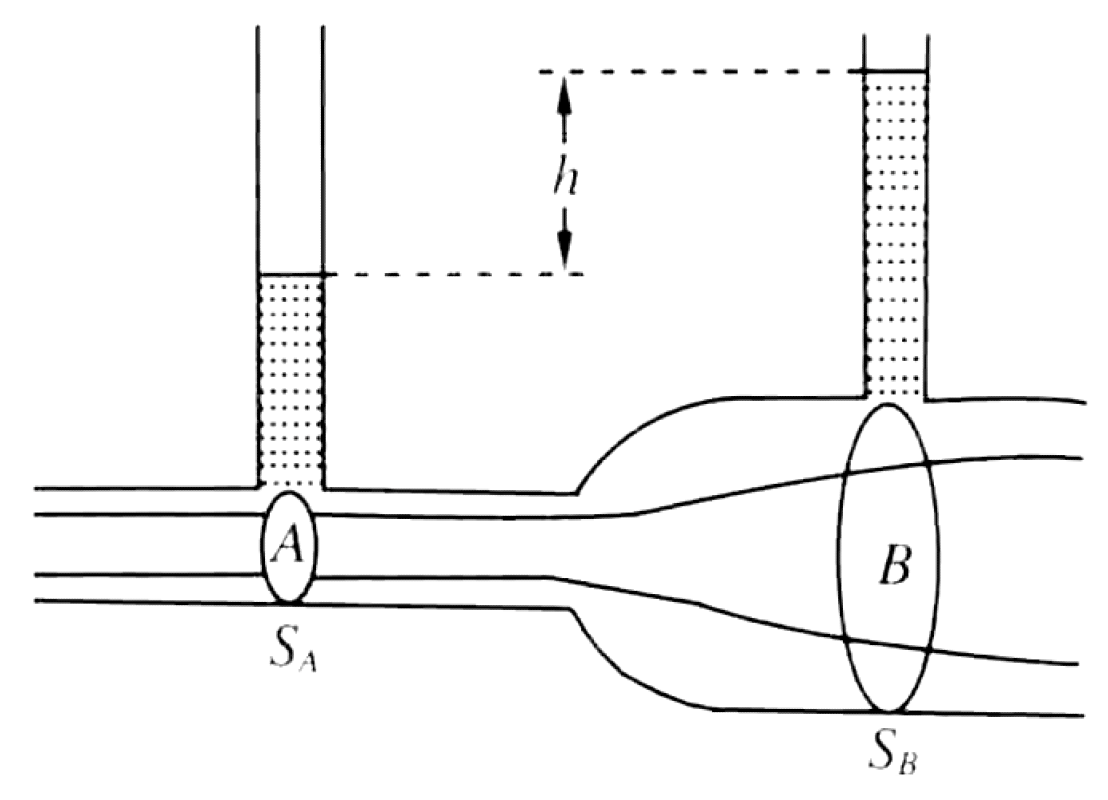
A simple Venturi meter, as shown in Figure, is a horizontal tube with varying cross-sections used to measure fluid flow rate. The flow rate $Q$ is the volume of fluid passing a cross-section per unit time, given by $Q=vS$, where $v$ is the fluid velocity and $S$ is the cross-sectional area. The difference in fluid height, $h$, in the two vertical tubes at sections A and B can be used to determine $Q$.
P0657-problem-1
The continuity equation for an incompressible fluid states that the flow rate $Q$ is constant.
$$Q = v_A S_A = v_B S_B$$This gives the velocities at sections A and B as $v_A = Q/S_A$ and $v_B = Q/S_B$.
For a horizontal pipe, Bernoulli's equation is:
$$P_A + \frac{1}{2}\rho v_A^2 = P_B + \frac{1}{2}\rho v_B^2$$The pressure difference between the two sections is determined by the height difference $h$ in the vertical tubes: $P_B - P_A = \rho g h$.
Combining these equations gives:
$$\rho g h = P_B - P_A = \frac{1}{2}\rho (v_A^2 - v_B^2)$$ $$2gh = v_A^2 - v_B^2$$Substitute the expressions for the velocities in terms of the flow rate $Q$:
$$2gh = \left(\frac{Q}{S_A}\right)^2 - \left(\frac{Q}{S_B}\right)^2 = Q^2 \left(\frac{1}{S_A^2} - \frac{1}{S_B^2}\right)$$ $$2gh = Q^2 \frac{S_B^2 - S_A^2}{S_A^2 S_B^2}$$Solving for $Q$ yields the desired expression:
$$Q^2 = \frac{2ghS_A^2S_B^2}{S_B^2 - S_A^2} \implies Q = \sqrt{\frac{2ghS_A^2S_B^2}{S_B^2 - S_A^2}}$$